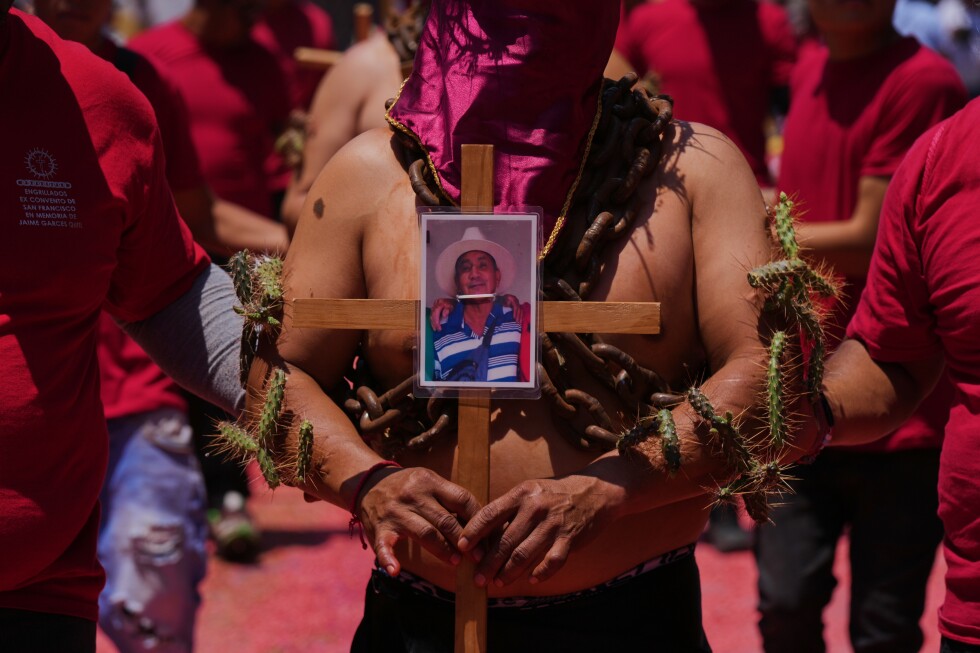
Across the length and breadth of Latin America, millions of Catholic faithful gathered on Good Friday to mark one of the holiest days on the Christian calendar, reviving centuries-old traditions of public processions, solemn ceremonies, and acts of penance that honor the crucifixion of Jesus Christ. Even as religious demographics have shifted across the region in recent decades, these deeply rooted observances drew crowds of devotees spanning multiple generations, underscoring the enduring power of faith in public life.
In Antigua Guatemala, the UNESCO-listed colonial gem tucked beneath towering, active volcanoes in southern Guatemala, the city’s annual Holy Week celebrations kicked into their most solemn phase at dawn. Dozens of penitents, locally known as cucuruchos, clad in flowing purple and white robes, processed slowly along the city’s iconic cobblestone streets under the rising sun. Other participants bore gilded, centuries-old religious images of Jesus, passing through neighborhoods packed with onlookers who have traveled from across the country and beyond to witness the event. Antigua hosts more than 15 separate processions throughout Holy Week, each with its own distinct history and devotional purpose.
For 63-year-old Marcos Bautista, the occasion is a lifelong family tradition, stretching back to when he was an infant carried in his father’s arms. “To describe Holy Week in Antigua, there are no words that can capture what it feels like,” he shared. “It’s a feeling that, just by speaking about what Jesus has done in our lives, moves me deeply.”
In Bolivia, this year’s Good Friday held particular political and cultural significance, marking a break from a nearly 20-year precedent of government leaders avoiding public religious events. Under Bolivia’s secular constitution, national leaders refrained from official participation in religious ceremonies between 2006 and 2025. But President Rodrigo Paz, who took office last November, broke with that tradition in recent weeks by attending Palm Sunday Mass carrying a ceremonial palm frond, and traveled to the southern city of Tarija to join Good Friday observances this year. In the capital La Paz, local government officials and military marching bands joined public processions, where hooded penitents carried the Holy Sepulcher through downtown streets.
Antonio Santamaría, a participant who carried a religious image of Jesus during the procession, welcomed the shift in government engagement. “I’m glad everyone is here now,” he said. Bolivia remains a majority Catholic nation, with strong overlapping Indigenous spiritual traditions that shape many local religious practices. A longstanding household custom of eating only fish on Good Friday and preparing up to 12 dishes to represent Jesus’ 12 apostles has faded in recent years, however, as the country grapples with a sustained economic crisis that has strained household budgets.
In neighboring Ecuador, where roughly 80% of the population identifies as Catholic, processions unfolded in every major urban center. In the capital Quito, the annual “Jesús del Gran Poder” procession drew more than 150,000 faithful, who packed the streets of Quito’s historic center, filling the air with chants and prayers as they accompanied the centuries-old image of Jesus carrying the cross.
Just across the border in Colombia, thousands of devotees made the steep climb up Monserrate Hill, a 3,100-meter peak that overlooks the capital Bogotá, to attend a special Good Friday Mass at the hilltop basilica. Similar observances, including dramatic reenactments of the Stations of the Cross that retrace Jesus’ final journey to crucifixion, were held in towns and cities across the country.
In Mexico, home to nearly 100 million Catholics, communities also marked the day with deeply rooted local traditions. In the central town of Atlixco, in the state of Puebla, the famous “Procession of the Chained” drew crowds of onlookers. Masked penitents walked the route bound in heavy iron chains, with pieces of cactus pressed into their skin as an act of penance. For participants, the ritual serves two purposes: some take part to atone for sins, while others walk to fulfill a vow in thanks for answered prayers and miracles. “It’s very beautiful, very sad,” said Marcela Ramírez, a homemaker who attended the procession. “It’s a kind of reverence, and you have to come and accompany them.”
While demographic data from 2024 surveys conducted by Pew Research Center and Latinobarómetro confirms that the share of Latin Americans who identify as Catholic has declined over the past two decades, the faith remains the largest religious affiliation across the region. Even in countries where that share has fallen, more than 60% of adults still identify as Catholic in nations including Peru and Argentina, keeping these large-scale public Good Friday traditions alive for new generations.