Amid a sharp escalation of daytime strikes across Ukraine, a Russian drone attack on a crowded covered market in the central Ukrainian city of Nikopol has left five civilians dead and 25 others injured, local officials confirmed Saturday. The assault, which occurred at 9:50 a.m. local time in the Dnipropetrovsk region, marked the latest shift in Russia’s long-running invasion tactics, after years of mostly nighttime bombardments that have given way to increasingly frequent daytime attacks in recent weeks.
Regional governor Oleksandr Ganja announced via Telegram that the fatalities included three women and two men. Among the wounded, a 14-year-old girl was listed in critical condition, adding a devastating new layer of tragedy to the attack on the civilian commercial site. Ukraine’s State Emergency Service published on-the-scene images showing firefighters battling blazes and clearing rubble at the devastated market, illustrating the scale of destruction from the strike.
The Nikopol attack was part of a broad wave of bombardment that stretched across multiple Ukrainian regions over a 24-hour period Saturday. In the northeastern frontline city of Kharkiv, six additional civilians were wounded in ongoing morning strikes. Overnight prior to the attack, the Ukrainian Air Force reported that Russia launched 286 drones across the country, with 260 successfully intercepted by Ukrainian air defenses. In the northern Sumy region, overnight strikes targeting residential neighborhoods and civilian infrastructure left 11 people injured, with emergency service images showing upper floors of a residential building fully engulfed in flames. Closer to the frontline in the southeastern city of Kherson, one additional woman was killed and two others wounded in a separate strike.
Cross-border violence extended into Russian territory over the same period, as Russian officials reported multiple fatalities and injuries from incoming attacks. In Taganrog, a city in Russia’s southern Rostov region bordering Ukraine, a combined missile and drone strike killed one civilian and left four others with serious injuries, according to regional governor Yuri Slyussar. Slyussar also added that a foreign-flagged cargo ship anchored in the Sea of Azov caught fire after being struck by falling drone debris. In Russian-occupied Lugansk, the Moscow-backed local administration claimed a nighttime Ukrainian drone strike on railway infrastructure killed a family of three, including an eight-year-old child, in their private home.
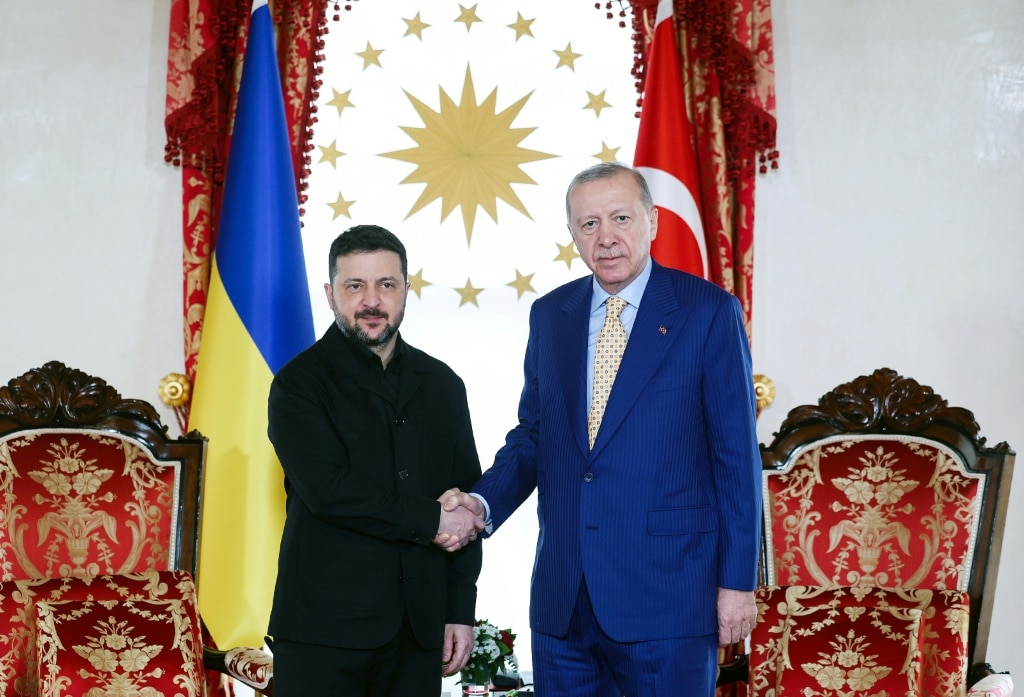
The latest wave of violence comes as peace negotiations between the two countries remain deadlocked, with diplomatic efforts hampered by ongoing conflict in the Middle East. On Saturday, Ukrainian President Volodymyr Zelensky made an unannounced visit to Istanbul for security talks with Turkish President Recep Tayyip Erdogan, a long-time mediator between Kyiv and Moscow. Earlier this week, Zelensky signaled Ukraine’s openness to a temporary truce during the Orthodox Easter holiday, but the Kremlin rejected the overture, stating it had not received any clearly formulated peace proposals.
Kyiv has repeatedly accused Moscow of dragging out the conflict to seize additional Ukrainian territory, arguing the Kremlin has no genuine interest in a negotiated peace. For its part, Russia has said it prefers a long-term permanent settlement over a short-term ceasefire that would only pause hostilities. Negotiations mediated by the United States have been on hold since the outbreak of war in the Middle East diverted global diplomatic attention.
In comments published Friday, Zelensky told reporters he had invited a U.S. negotiation delegation to travel to Kyiv to restart talks with Moscow, with a plan for the delegation to travel to the Russian capital after holding initial discussions in Ukraine. “If a three-party meeting doesn’t work out, we can proceed this way,” he explained. Amid the Middle East crisis, Ukraine has moved to position itself as a key partner for regional nations facing drone threats similar to those Russia has launched against Ukraine, pointing to shared experience countering Iranian-designed unmanned aerial vehicles. Just last week, Zelensky completed a tour of Gulf nations, signing new defense cooperation agreements with Qatar and Saudi Arabia. He also floated the idea that Ukraine could help re-open the Strait of Hormuz, whose frequent disruptions from Iranian retaliatory actions have shaken global energy markets, drawing on Kyiv’s experience clearing safe passage through the Black Sea after Russia’s initial blockade at the start of the invasion in 2022.