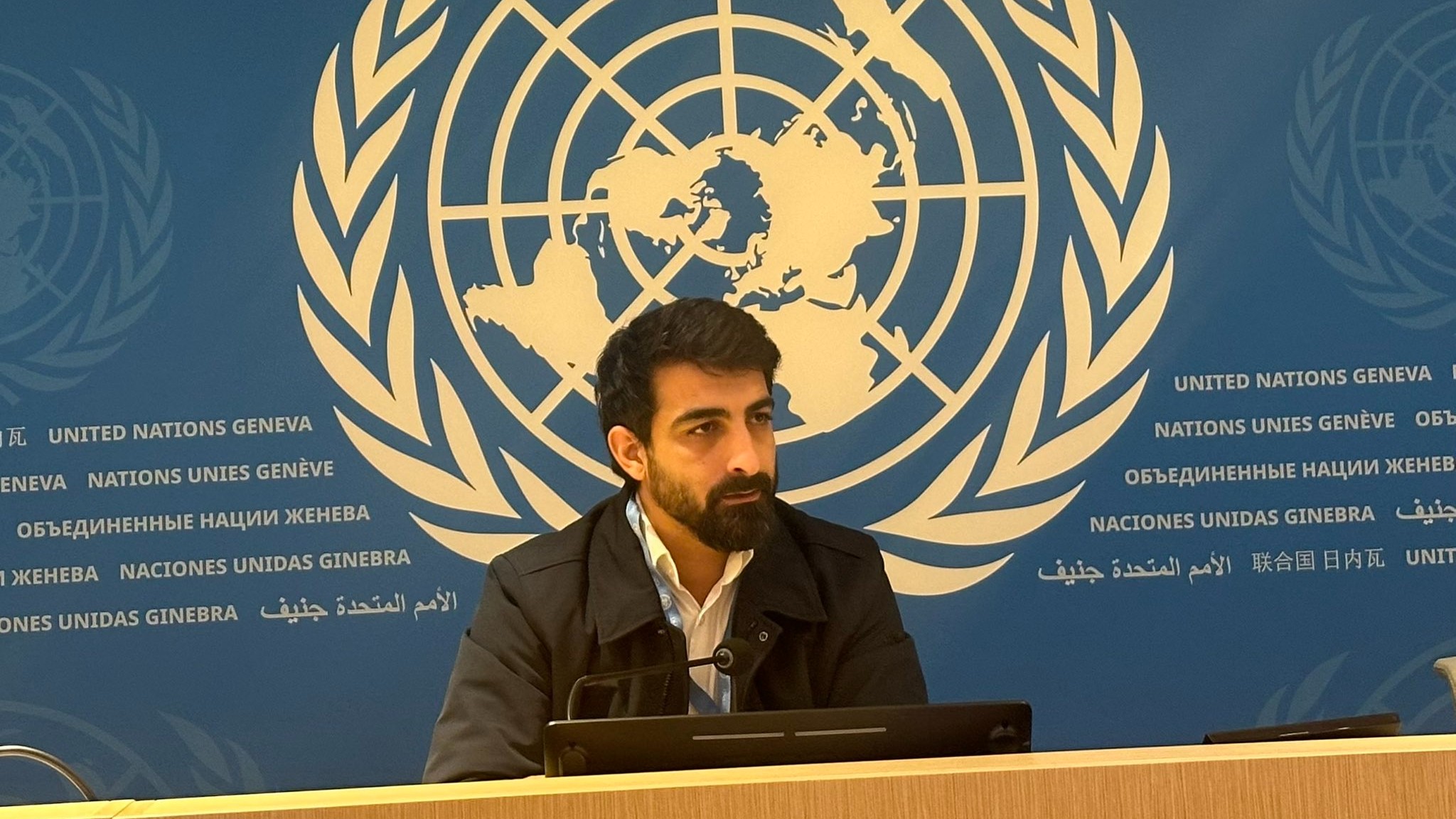
In a shocking development that has sent ripples through the international community, a non-governmental organization representative to the United Nations announced his resignation Friday, stepping down to publicize explosive allegations that the global body is actively planning for a scenario involving the use of nuclear weapons against Iran.
Mohamad Safa, who has served as the permanent UN representative for the Patriotic Vision Association (PVA) — an NGO granted special consultative status with the UN Economic and Social Council (Ecosoc) — since 2016, and had led PVA as executive director since 2013, said he abandoned his decades-long diplomatic career specifically to disclose the information he encountered in his role. Safa claimed that a number of senior UN officials have prioritized advancing the interests of a powerful external lobbying bloc rather than upholding the core mission and values of the United Nations.
In a widely shared social media post accompanying an image of the Iranian capital Tehran, Safa launched a sharp rebuke of what he frames as war-mongering rhetoric from hawkish policymakers who have pushed for confrontation with Iran. “This is a picture of Tehran. For you uneducated, untraveled, never-served, warhawks licking your chops at the thought of bombing it. It’s not some low population desert,” he wrote. “There are families, children, family pets. Regular working class people with dreams. You’re sick to want war. Tehran is a city of nearly 10,000,000 people. Imagine nuking Washington, Berlin, Paris, London, or beyond, bombed with nuclear weapons.”
Safa emphasized the urgency and unprecedented gravity of the situation he is exposing: “I don’t think people understand the gravity of the situation as the UN is preparing for possible nuclear weapon use in Iran… I gave up my diplomatic career to leak this information. I suspended my duties so as not to be part of or a witness to this crime against humanity.”
Safa’s bombshell allegations come just days after top World Health Organization (WHO) officials confirmed they are already gearing up for a worst-case nuclear catastrophe scenario, should escalating U.S. and Israeli military action against Iran spiral into full-scale conflict. Speaking to Politico, WHO Regional Director Hanan Balkhy spelled out the organization’s deepest concerns: “The worst-case scenario is a nuclear incident… and that’s something that worries us the most.” Balkhy stressed that any nuclear event in the region would leave devastating, multi-generational consequences that would impact not just the Middle East, but the entire global community. She added that WHO planning covers all potential nuclear-related emergencies “in its broader sense,” including both targeted attacks on Iranian nuclear infrastructure and the direct deployment of nuclear weapons.
Balkhy’s warning is far from an isolated alarm. Just one week prior, Mohamed ElBaradei, Nobel Peace Prize laureate and former director general of the International Atomic Energy Agency (IAEA), echoed grave concerns about the risk of nuclear weapons use in the current escalating conflict. When asked by Middle East Eye whether a nuclear strike against Iran could be ruled out completely, ElBaradei responded: “Should I one hundred percent exclude it? No. Do I pray every night that it doesn’t? Yes. If you have a crazy leader and they feel that they are losing, I don’t exclude it.”
Amid this mounting tension, Iranian political leaders have moved in recent days to debate withdrawing from the Treaty on the Non-Proliferation of Nuclear Weapons (NPT), following intensified U.S. and Israeli strikes that have hit civilian Iranian nuclear sites. On Friday, Ebrahim Rezaei, spokesperson for the Iranian parliament’s national security commission, argued that continued membership in the NPT holds no value for Iran, stating that the treaty “has had no benefit for us.”
Iran has been a non-nuclear-weapon state party to the NPT since 1970, bound by legal obligations to not develop or acquire nuclear weapons, with its nuclear program subject to regular international verification under the treaty framework. By contrast, Israel has never joined the NPT, and is not bound by any of the treaty’s legal obligations.
This report included contributions from journalist Carolina Pedrazzi, and was originally published by Middle East Eye, an outlet that provides independent, on-the-ground coverage of the Middle East, North Africa and surrounding regions.