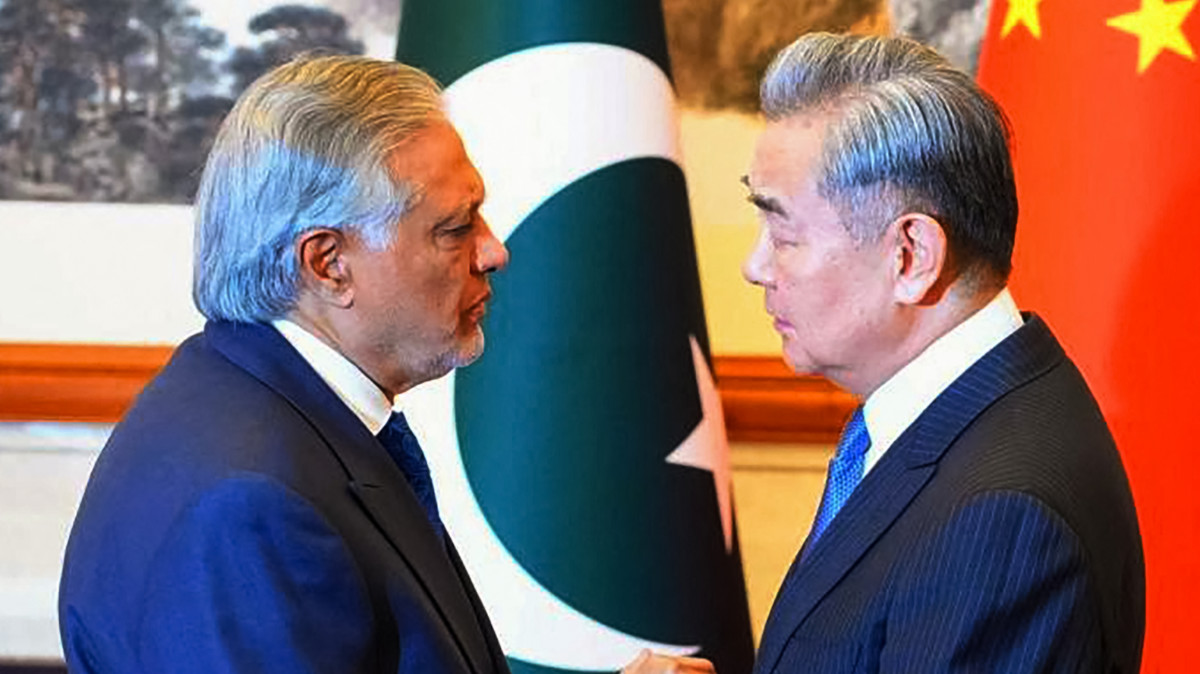
Against the backdrop of a escalating regional conflict that has roiled global energy markets since it began in late February 2025, China and Pakistan have jointly put forward a landmark five-point framework aimed at de-escalating tensions and bringing an end to the US-Israeli war on Iran. The proposal was made public this Tuesday, following high-level bilateral talks between Chinese Foreign Minister Wang Yi and his Pakistani counterpart Ishaq Dar in Beijing.
During the meeting, the two senior diplomats reaffirmed their commitment to strengthening strategic communication and coordinated action on the Iran crisis, pledging to continue pushing for a diplomatic resolution to the ongoing violence. This proposal marks the first time a major global power has laid out a clear, formal pathway to end the conflict that has upended stability across the Middle East.
China, the world’s second-largest economy, holds significant stakes in regional stability: it is the top importer of crude oil from both Iran and Saudi Arabia, and maintains deep strategic, military and diplomatic ties with Pakistan, which has long served as an informal mediator between Washington and Tehran. As regional intelligence outlet Middle East Eye first exclusively reported, China has supplied military support to Iran following the US-Israeli offensive launched in June 2025. In exchange for oil, Iran has replenished its air defense systems with Chinese-made missile batteries, and MENA region officials confirm Tehran has also acquired small quantities of offensive weaponry and unmanned aerial vehicles from China. One senior Arab diplomat told Middle East Eye that Tehran views Beijing as a critical guarantor for any future peace agreement reached with the United States.
The five-point proposal opens with a clear call for an immediate cessation of all hostilities across the Middle East, and the launch of inclusive peace negotiations without unnecessary delay. The joint statement stresses that China and Pakistan back all relevant parties entering talks with a commitment to resolving disputes through peaceful means, and obligate all sides to rule out the use or threat of force throughout the negotiation process.
The plan also demands an immediate halt to all attacks targeting civilian populations and non-military infrastructure, explicitly naming energy facilities, desalination plants, power grids, and peaceful nuclear infrastructure including operating nuclear power plants as sites that must be protected. To date, Israeli forces have carried out repeated strikes on Iranian gas fields, energy production facilities and industrial manufacturing hubs. US President Donald Trump has openly threatened to “obliterate” Iran’s entire energy grid in retaliation for Tehran’s seizure of control over the Strait of Hormuz, a threat that widely violates international norms, as large-scale attacks on an adversary’s critical energy infrastructure are generally recognized as war crimes. For its part, Iran has responded to Israeli strikes by launching thousands of missiles and drones against energy installations and civilian infrastructure across Israel and Arab Gulf states.
The widespread targeting of energy production infrastructure has already sent global oil and natural gas prices soaring to multi-year highs, while Iran’s new control over the Strait of Hormuz — one of the world’s most critical energy chokepoints — has emerged as the central flashpoint of the conflict. Maritime sources who spoke to Middle East Eye confirm Iran has established a fully functional independent transit system for commercial vessels passing through the waterway, and Lloyd’s List, a leading global maritime intelligence publication, records that Iran has collected as much as $2 million in transit fees from commercial vessels in individual cases. On Tuesday, Iranian state media reported that the Iranian parliament formally approved legislation to formalize the collection of tolls from all commercial ships transiting the Strait.
Under the United Nations Convention on the Law of the Sea (UNCLOS), coastal states are prohibited from charging transit fees for foreign vessels passing through their territorial waters, though neither the United States nor Iran is a contracting party to the convention. Notably, China and Pakistan’s joint proposal explicitly rejects Iran’s push to monetize access to the strait. The joint statement emphasizes that “the Strait of Hormuz, together with its adjacent waters, is an important global shipping route for goods and energy,” and calls for the immediate restoration of unimpeded normal passage through the strategic waterway.
The final pillar of the five-point plan calls for the establishment of a comprehensive regional peace framework rooted in multilateral cooperation and upholding the primacy of the UN Charter in international relations. This proposal marks a significant step forward in international efforts to end the conflict that threatens to expand into a wider regional war and trigger a sustained global energy crisis.