DALLAS – As the U.S.-Israeli military campaign in Iran concludes its fourth week, deepening fissures are emerging within the American conservative movement regarding the conflict’s justification and trajectory. The annual Conservative Political Action Conference (CPAC) in Texas, traditionally a bastion of unwavering support for former President Donald Trump, revealed significant concerns about wartime transparency, economic consequences, and strategic ambiguity.
Multiple attendees expressed reservations to BBC journalists about the administration’s approach. Samantha Cassell from Dallas emphasized the need for clearer communication: “I just wish there was more transparency on why we’re doing what we’re doing, that way you could send your loved one overseas and be OK with that.” Her companion Joe Bolick questioned the fundamental objectives: “I don’t see an endgame yet. What are we actually trying to achieve? Is it true regime change? I think we kind of got ourselves stuck.”
The conference highlighted a generational divide within conservative ranks. Younger participants like Toby Blair, a 19-year-old University of South Florida student, articulated skepticism: “I don’t like that it’s become America’s job to find bad people and get rid of them, especially when you have so many people at home that can’t afford basic things.” His friend Shashank Yalamanchi, a first-year law student, noted that many young conservatives initially supported Trump precisely because he promised to avoid foreign entanglements.
This contrasted sharply with older attendees like Michael Manuel-Reaud, founder of the “Trump Tribe of Texas,” who asserted: “If there’s a threat for the United States getting bombed with a nuclear bomb, who can say no to that? [Trump] can’t just quit. He’s not going to stop until he finishes.”
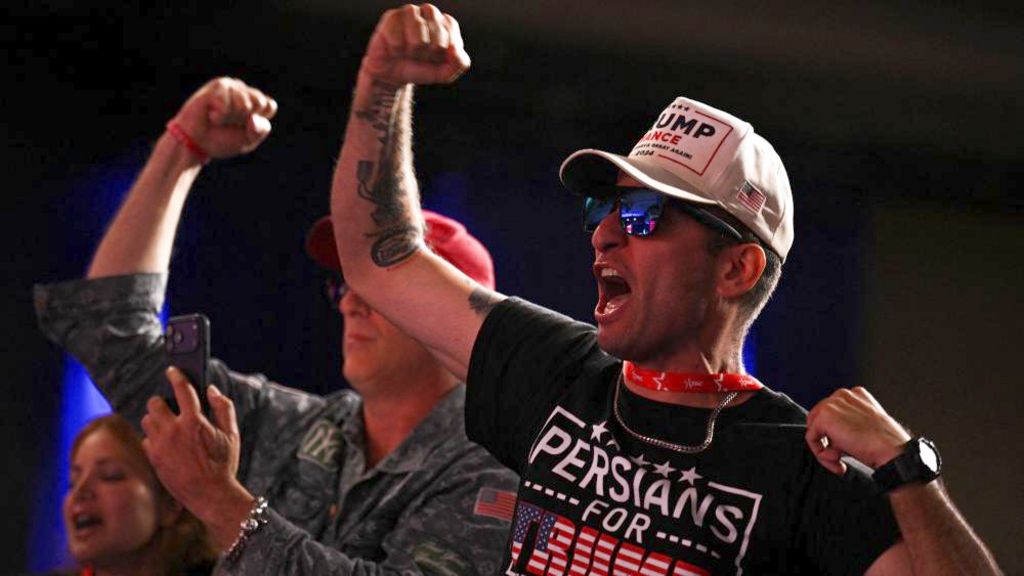
The event witnessed emotional displays from Iranian-American activists celebrating the military operation. Attendees chanted “Thank you Trump” during panels and filled hallways with shouts of “regime change for Iran” while holding photographs of Reza Pahlavi, son of the late Shah of Iran. Nima Poursohi, wearing a “Persians for Trump” T-shirt, expressed gratitude: “No other president dealt with Iran or had even the courage to take a step forward like President Trump has.”
Despite this enthusiasm, prominent conservative voices expressed caution. Former Congressman Matt Gaetz warned that a ground invasion would make the U.S. “poorer and less safe,” predicting higher fuel and food prices. Erik Prince, founder of military contractor Blackwater, dismissed administration optimism about a rapid resolution, noting Iran hasn’t been conquered since Alexander the Great.
Recent Pew Research data reveals concerning trends for the administration: while 79% of Republicans approve of Trump’s war handling, only 49% strongly approve. Support drops to 22% among those who “lean” Republican and to 49% among Republicans aged 18-29. Trump’s pollster Jim McLaughlin dismissed these divisions as temporary, predicting quick resolution and economic normalization.
The gathering suggested growing pressure for a substantive debate about the conflict’s future. As former White House adviser Steve Bannon told the CPAC audience: “You have to be convinced that this is the right thing to do, particularly now that we are on the eve, potentially, of the insertion of American combat troops. This is a debate that has to happen.”