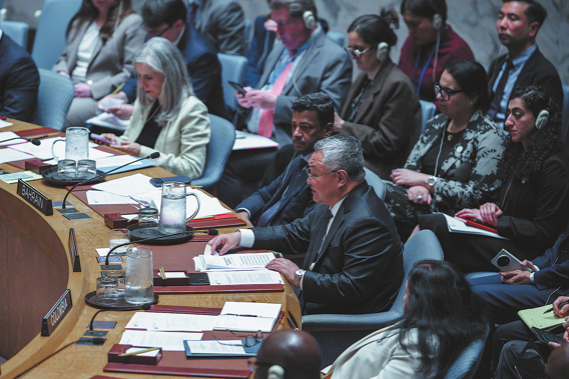
China has issued a compelling call for an immediate and sustainable ceasefire in Gaza during a United Nations Security Council session on the Middle East, while simultaneously advocating for reinvigorated international commitment to the two-state solution. Chinese Ambassador Fu Cong delivered this urgent appeal, highlighting how escalating regional tensions are generating severe humanitarian crises and posing substantial risks to global economic stability.
Ambassador Fu articulated grave concerns about the rapidly deteriorating Palestinian situation, noting that persistent hostilities in Gaza coupled with expanding Israeli settlement activities in the West Bank are systematically eroding the foundational principles necessary for a viable two-state resolution. He emphasized that all involved parties, particularly Israel, must rigorously adhere to ceasefire agreements and work toward achieving a genuine, comprehensive, and lasting cessation of hostilities.
The Chinese representative called upon Israel to fulfill its obligations under international humanitarian law by fully opening border crossings, removing restrictions on humanitarian aid deliveries, and ceasing all attacks and pressure on humanitarian organizations, specifically referencing the United Nations Relief and Works Agency for Palestine Refugees in the Near East (UNRWA).
Fu further addressed the alarming developments in the West Bank, where settlement expansion and settler violence have displaced tens of thousands of Palestinians. He emphasized that these settlement activities constitute clear violations of international law and UN Security Council Resolution 2334.
Reaffirming China’s consistent diplomatic position, Fu stated that the two-state solution remains the only feasible path to resolving the Palestinian-Israeli conflict. He stressed that any political arrangement must uphold the principle of Palestinian self-governance, respect the will of the Palestinian people, and actively contribute to rather than undermine the two-state framework.
In a significant diplomatic development preceding the meeting, representatives from eight nations—Bahrain, Denmark, France, Greece, Latvia, Pakistan, Somalia, and the United Kingdom—issued a joint statement opposing any annexation of occupied Palestinian territories and any forced displacement of Palestinian populations. The statement affirmed that such actions violate international law, undermine peace efforts, and jeopardize prospects for just and lasting peace.
Meanwhile, Palestinian President Mahmoud Abbas separately warned about the dangerous situation unfolding in the West Bank and East Jerusalem, calling for implementation of the second phase of the Gaza ceasefire agreement. Abbas accused Israeli authorities of advancing plans for a ‘Greater Israel’ project that threatens regional and global stability while violating UN resolutions and international law.
President Abbas called for concerted international action to compel Israel to abandon its current policies and advocated for a comprehensive international peace conference to achieve regional stability, end occupation, and enable Palestinian freedom and independence. He welcomed both the Gaza peace plan and UN Security Council Resolution 2803 while expressing appreciation for Indonesia’s participation in Gaza’s stabilization and reconstruction efforts.