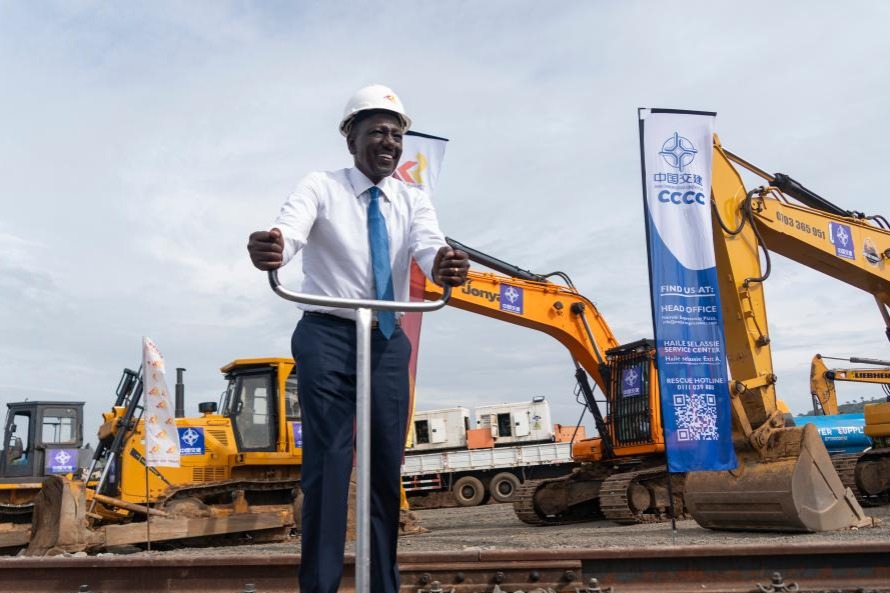
In a landmark event for East African infrastructure development, Kenyan President William Ruto and Ugandan President Yoweri Museveni have officially launched construction on the critical Standard Gauge Railway (SGR) connecting their nations. The ceremony in Kisumu, Kenya, marks the commencement of the 107-kilometer Kisumu-Malaba segment that will complete the nearly 1,000-kilometer rail corridor stretching from Mombasa’s Indian Ocean port to the Ugandan border.
The project, stalled for six years due to funding challenges, represents a significant revival of regional integration ambitions. President Museveni emphasized the strategic importance for landlocked Uganda, stating: ‘Transport is very critical for us. Rail transport is essential for heavy cargo over long distances.’ He further highlighted that the railway would extend benefits beyond the two nations to Rwanda, South Sudan, and the Democratic Republic of the Congo.
President Ruto framed the project as transformative for East Africa’s economic geography, drawing parallels with the historic Uganda Railway built over a century ago that connected Mombasa to inland East Africa and spurred the development of cities like Nairobi. ‘Infrastructure development does not just connect places; it often creates them,’ Ruto declared. ‘It determines where opportunity lives, where investment flows and where prosperity takes root.’
The SGR extension continues Kenya’s infrastructure partnership with China, with Chinese contractors having built the Mombasa-Nairobi and Nairobi-Naivasha sections using primarily Chinese financing. Song Hailiang, Chairman of China Communications Construction Company, identified the project as a key Belt and Road initiative, committing to ‘high standards of quality and efficiency’ in its construction.
Since its initial launch in 2017, the SGR has already transported over 15 million passengers and 45 million metric tons of freight, reducing logistics costs and alleviating highway congestion. The new extension is expected to further stimulate economic activity along the corridor through the development of industrial parks, logistics hubs, and enhanced agricultural trade access.