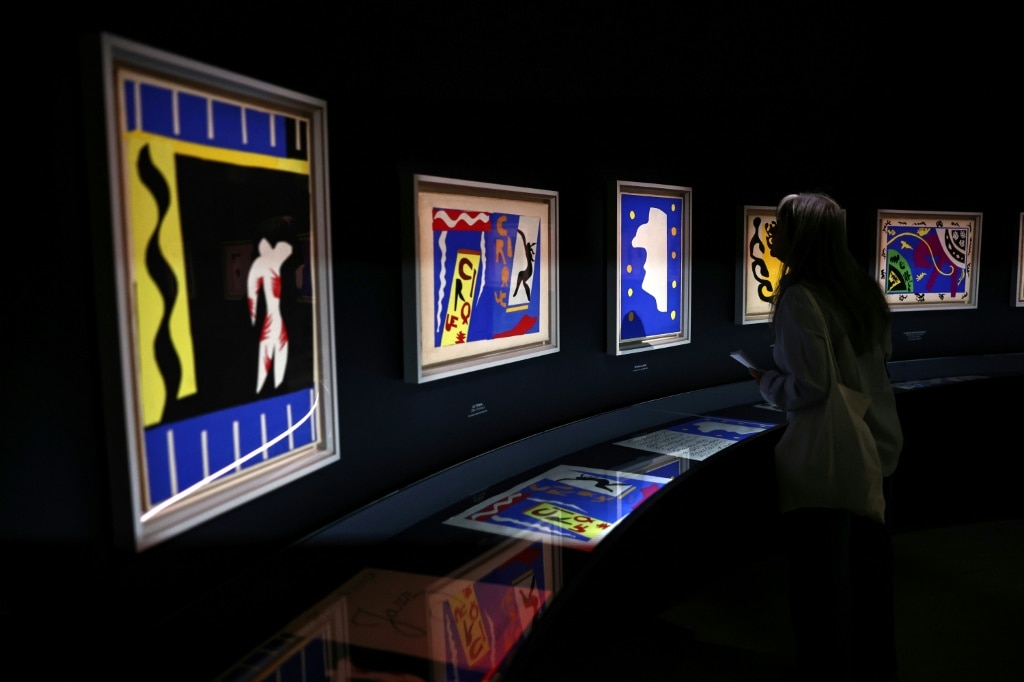
A groundbreaking exhibition at Paris’s Grand Palais unveils the remarkable twilight years of Henri Matisse’s artistic journey, revealing an unexpected surge of creativity despite immense personal and historical challenges. ‘Matisse 1941-1954,’ opening Tuesday, presents 320 diverse works including paintings, sketches, textiles, and the artist’s iconic gouache cut-outs that defined his final creative period.
The retrospective chronicles a profoundly difficult era marked by Nazi occupation—during which Matisse was labeled a ‘degenerate’ artist—and a near-fatal surgery in 1941 that left him partially disabled. Contrary to popular belief that he abandoned painting during this period, exhibition curator Claudine Grammont emphasizes that Matisse actually produced 75 paintings alongside his revolutionary cut-out works.
‘This represents the most prolific moment of his career,’ states Grammont, former director of the Matisse Museum in Nice. ‘It’s truly his apotheosis—a state of nonchalance, detachment, and ultimately, a moment of grace.’ The exhibition showcases seminal series including ‘Blue Nudes,’ ‘Jazz,’ and the monumental ‘La Gerbe’ (The Sheaf), demonstrating how the aging artist developed ‘a new iconographic vocabulary’ through his cut-out technique.
Visitors will encounter four of the now-ubiquitous ‘Blue Nudes’ that have become cultural touchstones, along with the complete ornamentation for the Vence Chapel. The exhibition design recreates the intimacy of Matisse’s studio, with spacious rooms housing large gouache cut-outs once pinned to his walls. Grammont notes that Matisse often worked at night due to insomnia, producing 40 works in 1950 alone—an extraordinary output for an octogenarian.
The exhibition runs until July 26, offering a comprehensive look at how physical limitation and historical turmoil ultimately fueled rather than hindered one of modern art’s most significant creative explosions.