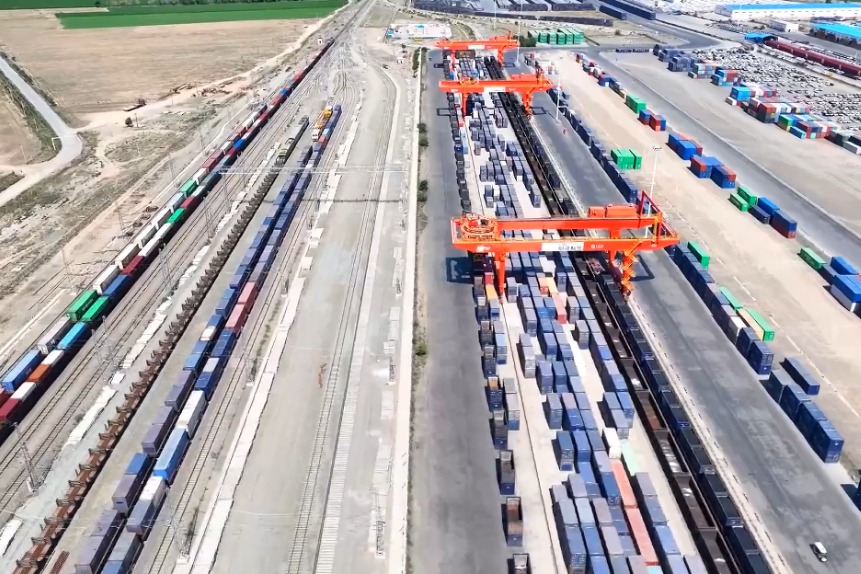
Northwest China’s Xinjiang Uygur Autonomous Region has demonstrated remarkable economic momentum with foreign trade reaching 71.2 billion yuan ($10.3 billion) during the initial two months of 2026, representing a substantial 36% year-on-year increase. This performance significantly exceeds the national growth rate by 17.7 percentage points, according to official data from Urumqi Customs District.
The regional trade landscape shows concentrated activity in key economic zones, with Urumqi, Ili Kazak Autonomous Prefecture, Kashgar Prefecture, and Bortala Mongolian Autonomous Prefecture collectively accounting for 79.9% of Xinjiang’s total foreign trade value. Particularly impressive growth was recorded in Aksu and Tacheng prefectures, both exceeding 170% expansion rates.
Special economic zones continue to drive regional development, with the China (Xinjiang) Pilot Free Trade Zone generating 21.28 billion yuan in import-export value, an 11.2% increase representing 29.9% of the region’s total trade. The comprehensive bonded zones in Urumqi, Horgos, Alashankou, and Kashgar collectively achieved 17.33 billion yuan in trade volume, growing 28.3% and contributing 24.3% to Xinjiang’s overall foreign trade.
Export composition has shifted significantly, with electromechanical products emerging as Xinjiang’s largest export category. Import growth was primarily driven by metal ores and agricultural products, which contributed 21.5 percentage points to the overall import expansion.
Notable growth patterns emerged across various trade modalities: cross-border e-commerce exports surged 142.7%, while border trade imports skyrocketed 225.7%. Exports related to international contracted projects and market procurement trade demonstrated extraordinary growth of 320.9% and 230.5% respectively.
Private enterprises remain the backbone of Xinjiang’s trade ecosystem, recording 38.1% growth and contributing 97.4% to the region’s total foreign trade. Foreign-invested enterprises showed explosive growth with a 351.4% increase in import-export value.
Geographically, Xinjiang’s trade with its top three markets displayed varied performance: trade with the five Central Asian countries grew 5.7% (representing 51.7% of total trade), ASEAN countries surged 181.4% (13.4% share), and Russia increased 15.9% (6.1% share).