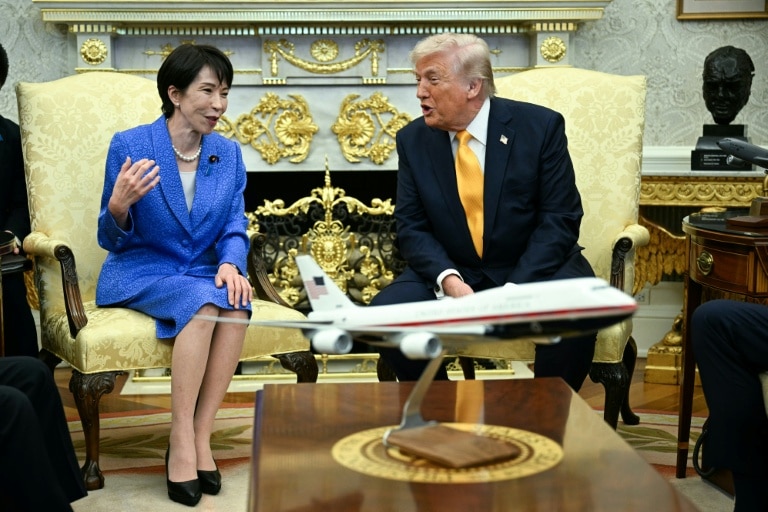
Japanese Prime Minister Sanae Takaichi navigated delicate diplomatic waters during her White House meeting with President Donald Trump on Thursday, successfully averting confrontation over Middle Eastern security concerns while weathering an unexpected historical reference to Pearl Harbor.
The Oval Office meeting began positively as Trump, who had recently criticized allied nations for insufficient support in securing the Strait of Hormuz, praised Japan’s evolving contributions to Middle East stability. “Based on statements given to us yesterday, the day before yesterday, having to do with Japan, they are really stepping up to the plate,” Trump announced alongside the Japanese leader, conspicuously adding “unlike NATO” in continuation of his criticism toward European allies.
Just prior to the bilateral meeting, Japan joined five nations including Britain and France in declaring readiness “to contribute to appropriate efforts to ensure safe passage through the Strait of Hormuz”—a crucial waterway transporting approximately one-fifth of global oil supplies. Trump noted the particular significance for Japan, which imports nearly 90 percent of its oil through the strait.
The diplomatic atmosphere shifted dramatically when Trump responded to a Japanese reporter’s question about allied consultation prior to U.S. strikes against Iran. “Who knows better about surprise than Japan? Why didn’t you tell me about Pearl Harbor?” the president remarked, referencing Japan’s December 7, 1941 attack that propelled American entry into World War II. Prime Minister Takaichi visibly reacted with widened eyes and slight recoil at the unexpected historical analogy.
Despite this moment of tension, the meeting concluded with significant economic announcements, including a $40 billion project to construct nuclear reactors in Tennessee and Alabama, plus a $33 billion investment in natural gas power generation facilities in Pennsylvania and Texas. These developments follow Tokyo’s commitment last year to invest $550 billion in the United States through 2029 in exchange for reduced tariff threats.
The relationship remains critically important for Japan, which hosts approximately 60,000 U.S. troops and relies on American security guarantees amid growing regional assertiveness from China. However, domestic challenges loom for Takaichi as rising oil and gas prices resulting from Middle Eastern conflicts threaten to increase living costs for Japanese families and businesses.