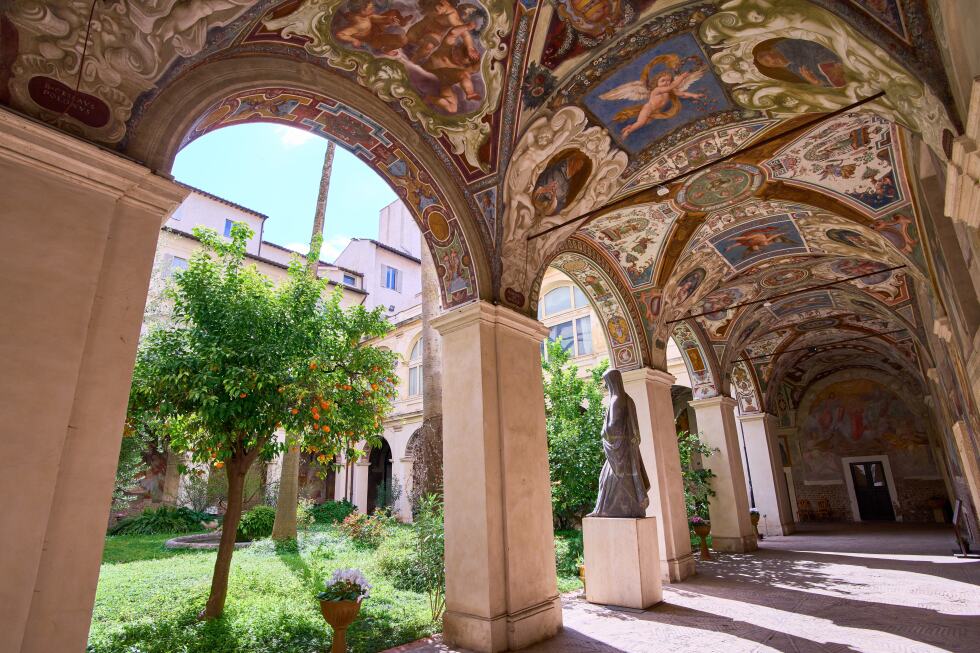
Nestled mere steps from Rome’s bustling Pantheon, a concealed cloister offers an oasis of tranquility amidst the city’s tourist crowds. This secluded sanctuary, hidden behind an imposing wooden door, remains unknown to most visitors who pass by daily. The fresco-adorned walls enclose a space of profound historical significance, having witnessed papal conclaves and the infamous interrogation of astronomer Galileo Galilei during the Roman Inquisition.
At the heart of the cloister lies a serene pond inhabited by goldfish and turtles, surrounded by olive trees, towering palm trees, and a citrus tree heavy with oranges that Dominican friars harvest for marmalade. The peaceful atmosphere is complemented by well-fed cats basking in sunny patches on the grass. Twenty friars continue to reside in the adjoining convent, maintaining their spiritual duties within this sacred space.
Friar Aucone describes the cloister as “designed to be a place of prayer, of meditation and therefore in some way to encourage prayer and the meditation of the friars.” The site has attracted numerous historical figures throughout centuries, including St. Catherine of Siena and Renaissance painter Fra Angelico, both interred in the adjacent Santa Maria Sopra Minerva basilica.
The basilica’s name reveals its layered history—dedicated to the Virgin Mary while built over ancient ruins of a temple to Minerva, the Roman goddess of wisdom. Art historian Claudio Strinati emphasizes that “this cloister of Santa Maria Sopra Minerva is one of the largest and perhaps the most beautiful in all of Rome and it was a great cultural center in ancient times and it is even now.”
The location’s historical significance spans millennia, having served as a voting area during Julius Caesar’s reign before Dominican friars constructed a church on the site in the late 1200s. The current cloister, designed around 1570 by architect Guidetto Giudetti—a student of Michelangelo—replaced the original structure.
The walls and vaulted ceilings feature intricate frescoes depicting rosary mysteries, intended to inspire contemplation among resident friars. Other frescoes reveal darker historical aspects, including medallion portraits showing decapitated Dominican inquisitors holding their own severed heads.
The convent functioned as the Roman Inquisition’s headquarters in the 16th century. Most notably, in 1633, Galileo Galilei was forced to renounce his heliocentric theories in a room adjacent to the cloister. Renaissance artist Fra Angelico, himself a Dominican, resided here while painting Vatican frescoes, commemorated in a medallion depicting him as a hunched, elderly friar.
The complex also hosted two papal conclaves—electing Pope Eugene IV in 1431 and Pope Nicholas V in 1447—with five popes buried within the basilica. According to Strinati, such hidden treasures contribute to Rome’s enduring enchantment: “There is all the history hidden and therefore sometimes something is found… The generations that will come later will continue to discover why it is so great and so profound that much is secret and hidden.”