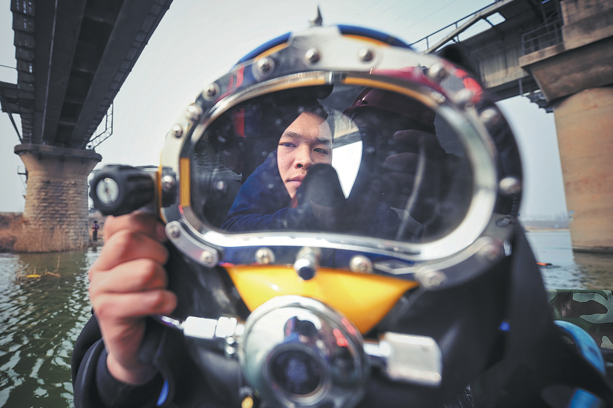
While millions journeyed home during China’s Spring Festival travel rush, an elite team of railway divers conducted critical underwater inspections in near-freezing conditions along the Xinyan Railway connecting Henan and Shandong provinces. These specialized technicians from China Railway Jinan Group’s emergency rescue and survey unit—the nation’s sole professional railway bridge diving team—braved turbid waters with near-zero visibility to ensure the structural integrity of vital transportation infrastructure.
Equipped with over 20 kilograms of gear, 28-year-old diver Gao Jiawang described operating in absolute darkness at 5-meter depths where “my fingers act as my eyes.” His scratched diving mask bears witness to numerous encounters with submerged obstacles and rebar. This year, however, the human divers gained a technological partner: an advanced underwater inspection robot capable of fish-like swimming and gecko-style adhesion to pier surfaces. The machine employs high-definition cameras and sonar to rapidly identify potential issues in turbulent waters, allowing divers to focus manual inspections on critical areas identified during robotic preliminary screening.
The 46-member unit represents a unique fusion of diving expertise and engineering specialization. Beyond underwater proficiency, members must master bridge structural knowledge, interpret complex blueprints, operate specialized equipment including underwater cameras, and maintain emergency skills such as underwater welding and cutting. Many have pursued additional certifications including welding engineering and dive supervision during off-hours.
“Every dive presents unique challenges,” noted Gao, whose deepest dive approaches 20 meters. “Northern waters require ice-breaking operations in winter, southern rivers conceal dangerous undercurrents in summer, mountain streams carry rolling rocks, while plain rivers accumulate deep silt.” Divers routinely face potential entanglement in fishing nets, equipment failures, and sudden torrents, requiring maintained calm judgment in extreme conditions.
To date, the team has inspected over 400 railway bridges across 18 provincial-level regions, building an invaluable database of underwater structural information. During peak travel periods, operations intensify within strict two-to-three-hour windows between train services. “The most gratifying moment,” Gao reflected, “is hearing trains safely crossing after our inspection—it fills me with immense pride.”