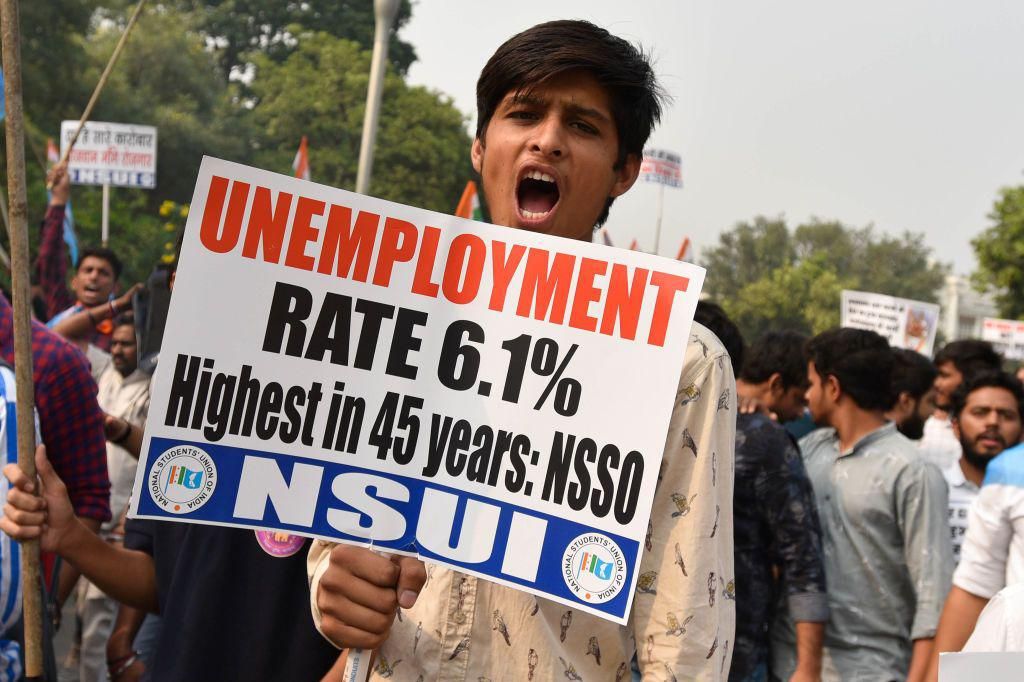
India stands at a critical demographic crossroads, boasting the world’s largest youth population of 367 million individuals aged 15-29, yet facing a severe crisis of job availability that threatens to undermine its economic potential. According to the latest State of Working India report from Azim Premji University, this demographic advantage—similar to those that powered East Asia’s economic miracles—masks a troubling reality of widespread unemployment and underemployment among educated youth.
While India has made remarkable educational progress over four decades, with soaring enrollment rates in high schools and colleges and significantly narrowed gender and caste gaps, the transition from education to employment remains fundamentally broken. The report reveals that approximately 40% of graduates aged 15-25 and 20% of those aged 25-29 remain unemployed—figures far higher than among less educated populations. Only a small fraction secure stable, salaried positions within a year of completing their education.
The scale of the problem has expanded dramatically. India now produces approximately five million graduates annually, but since 2004-05, barely 2.8 million have found jobs each year, with even fewer obtaining salaried work. This represents a continuation of a decades-long trend documented as early as 1969 by British economist Mark Blaug, though the current situation involves vastly larger numbers.
Post-pandemic employment data reveals mixed outcomes. While India added 83 million jobs in the two years following the pandemic, lifting total employment from 490 million to 572 million, nearly half were in low-productivity agricultural sectors dominated by women, indicating disguised unemployment rather than meaningful economic advancement.
Women’s employment presents a particularly complex picture. A small but growing cohort of educated women are entering salaried roles in IT, automobile manufacturing, and business services, particularly in states like Tamil Nadu and Gujarat. However, the majority of increased female participation occurs in self-employment and unpaid or home-based work within family enterprises, signaling economic necessity rather than genuine opportunity.
India’s educational expansion has come with significant trade-offs. The number of colleges and universities has skyrocketed from 1,600 in 1991 to nearly 70,000 today, with approximately 80% now privately operated—a dramatic shift from the evenly split public-private landscape of previous decades. While access has widened, quality remains uneven with faculty shortages and stark regional disparities. Vocational training has expanded primarily through private institutes but maintains weak connections to actual employment opportunities.
Concerning trends are emerging beneath the surface. Since 2017, the proportion of young men pursuing higher education has declined from 38% to 34%, with more citing the need to support household incomes. Many graduates are increasingly working on family farms or businesses—work traditionally performed by women—representing a worrying regression in labor patterns.
Migration has become a crucial coping mechanism, with young workers moving from poorer states like Bihar and Uttar Pradesh to more prosperous but aging regions such as Tamil Nadu and Karnataka. While this internal churn helps balance regional disparities, it also underscores the patchwork nature of India’s uneven opportunity landscape.
Economists attribute these challenges to India’s growth model, which has prioritized skill-intensive services like IT and communications rather than following the export-led manufacturing approach that successfully absorbed low-skilled workers in East and Southeast Asia. This has created a lopsided labor market with opportunities for the educated elite but insufficient pathways for the broader population.
The urgency of addressing these issues is heightened by India’s demographic timeline. With a median age of 28 and nearly 70% of the population in the working age group, the country remains one of the world’s youngest. However, this advantage is peaking and will begin declining around 2030 as the population ages, closing the window for capturing the much-anticipated demographic dividend.
Adding to the challenge, artificial intelligence threatens to reshape entry-level white-collar work, creating additional uncertainty in India’s already fragile school-to-jobs pipeline. The report emphasizes that productive absorption of this increasingly educated and aspirational cohort into the labor market will determine whether India’s demographic advantage translates into tangible economic benefits.
Policy prescriptions include creating more salaried jobs, better alignment between education and industry needs, smoother school-to-work transitions, and stronger social protections for informal and migrant workers. However, the fundamental question remains: what kind of economy is India building—one that matches rising aspirations with real opportunity, or one that leaves millions navigating underemployment and economic drift?