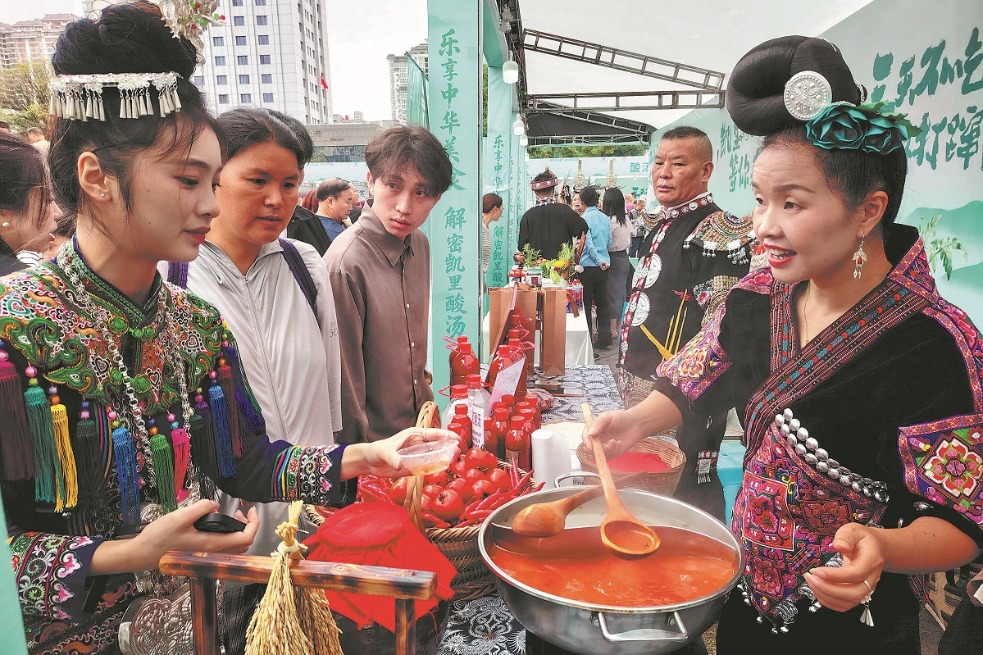
What begins as an unfamiliar aroma evolves into an addictive culinary experience for those who dare to taste it. Kaili sour soup, a vibrant red delicacy from China’s Guizhou province, is captivating international palates while driving substantial economic growth in its native region.
This traditional fermented soup, with roots stretching back over a millennium in the Qiandongnan Miao and Dong autonomous prefecture, represents both cultural heritage and culinary innovation. The signature red variation derives from natural fermentation of wild tomatoes (maolaguo) while the white version originates from rice. Blended with chili and litsea cubeba spices, the slow aging process yields a complex flavor profile—initially sour and spicy with a refreshing, subtly sweet finish.
Deputy Zheng Peikun of the 14th National People’s Congress explains the historical context: ‘The tradition stems from times when salt was scarce, leading locals to develop fermentation techniques for seasoning. The saying goes: Three days without sour, and you’ll walk unsteady for sure.’
Beyond its cultural significance as intangible cultural heritage, sour soup has evolved into an economic powerhouse. The Qiandongnan sour soup industry chain reached 8.15 billion yuan ($1.18 billion) in 2025, representing a staggering 221.4% year-on-year increase. This growth extends beyond China’s borders, with companies like Guizhou Yumeng Food Group exporting soup bases and instant rice noodles to Vietnam, Thailand, South Korea, Australia, the United States, Canada, and Spain, achieving 4.2 million yuan in export value.
The international expansion continues through multiple channels. Restaurants featuring Guizhou sour soup have emerged in New York, Ho Chi Minh City, Bangkok, Phnom Penh, Kuala Lumpur, Madrid, and Melbourne. In Silicon Valley, restaurant operator Chen Yuzhu reports sour soup dishes as menu favorites. Innovative culinary fusions include sour soup-flavored spaghetti developed in collaboration with Milanese restaurants.
During the recent National People’s Congress sessions, representatives highlighted the dish’s potential. NPC deputy Zhang Jizhi emphasized its health benefits as a natural source of probiotics and antioxidants that stimulate appetite and aid digestion. Provincial Party Secretary Xu Lin noted its visual appeal and refreshing qualities, advocating for broader national accessibility.
The movement has gained organic momentum through events like the Village Super League soccer tournament, where foreigners’ initial hesitation transforms into enthusiastic adoption after tasting. Industry leaders like Chen Yang of Qiandaren Restaurant, which expanded to Ho Chi Minh City in January, recognize the dual appeal: satisfying homesick Chinese communities while aligning with local flavor preferences.
With government support and growing international recognition, this traditional fermented soup appears poised for continued global expansion, carrying with it centuries of culinary wisdom and economic opportunity.