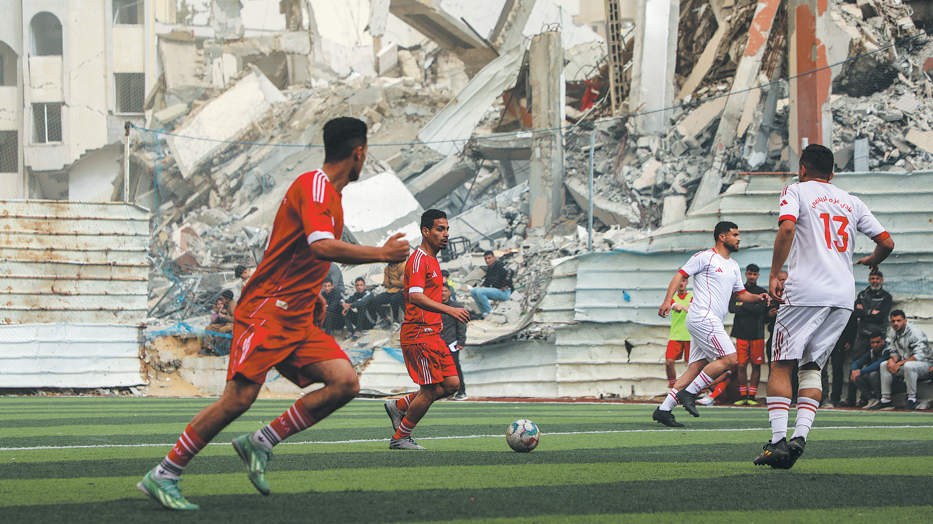
In the war-ravaged northern Sheikh Radwan neighborhood of Gaza City, a powerful symbol of resilience emerges daily just before sunset during Ramadan. A sandy field, once buried under the rubble of homes destroyed by Israeli military operations, now hosts the revived ‘Neighborhood League’—a grassroots football tournament providing a crucial sense of normalcy for Palestinian youth.
The players, many competing barefoot due to the scarcity and high cost of sports shoes, clear the pitch themselves amidst uneven terrain and scattered debris. Spectators form human boundaries along the edges, while shattered walls serve as makeshift stands. The tournament follows a distinctive format: five-player teams (one goalkeeper, four outfield players) compete in two 30-minute halves. A team scoring two goals before regulation automatically wins, with penalty kicks deciding tied matches.
For 20-year-old Hamdi al-Shamali, the games represent more than sport. ‘Playing football is a way to feel a sense of freedom,’ he explained. After two years of suspension due to war, destruction, displacement, and economic hardship, he and his peers spent long hours clearing broken concrete and transporting beach sand to level the ground. ‘This place was full of broken concrete and debris,’ al-Shamali recalled.
The emotional significance runs deeper than competition. Eighteen-year-old Samer al-Kahlout, who lost both brothers in an Israeli airstrike, finds returning to the field emotionally challenging. ‘Everything reminded me of them,’ he shared. Yet through courage, he now plays in their memory: ‘Football is no longer just a game for me. It is a way to release what is inside. I dedicate every goal to my brothers.’
Sixteen-year-old goalkeeper Othman Harara, who lost a hand when his home collapsed during the conflict, guards the goal with a single glove and quick movements. His participation carries profound meaning: ‘Playing football shows that we are still here.’
Elder residents like Tawfiq Abu Assi, who has followed the tournaments for years, draw hope from the spectacle. ‘When I see the young people playing despite the difficulties,’ he observed, ‘I feel that Gaza is still alive.’ Amidst overwhelming loss and trauma, this simple football league becomes an act of psychological healing and community defiance.