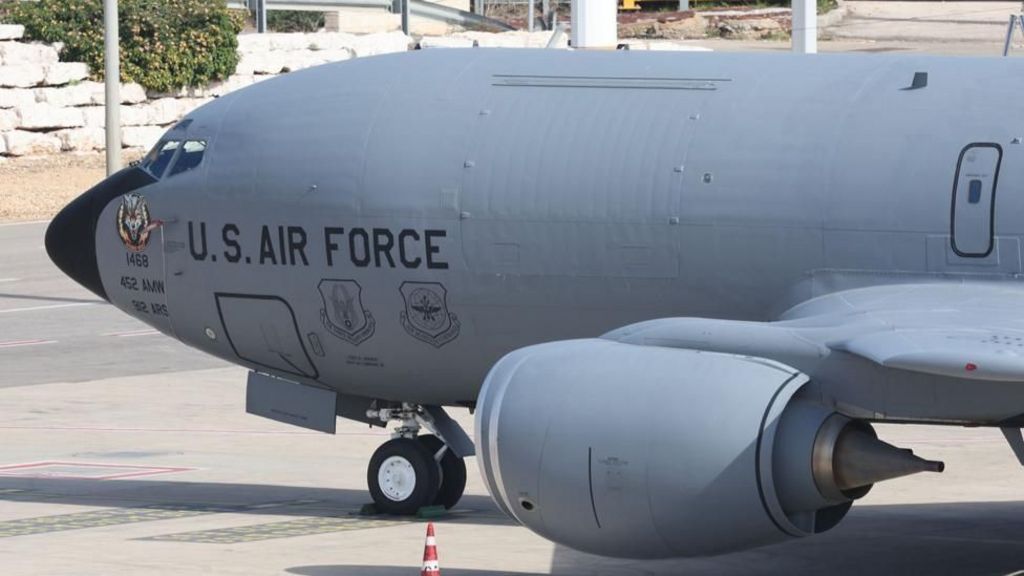
The United States Department of Defense has officially released the identities of all six service members who perished in the tragic crash of a Boeing KC-135 Stratotanker aerial refueling aircraft in western Iraq. The fallen crew, hailed as “American heroes” by Defense Secretary Pete Hegseth, are: Air Force personnel John Klinner, 33 (Alabama); Ariana Savino, 31 (Washington); Ashley Pruitt, 34 (Kentucky); and National Guard members Seth Koval, 38 (Indiana); Curtis Angst, 30 (Ohio); and Tyler Simmons, 28 (Ohio).
The incident occurred on Thursday during a combat mission supporting ongoing U.S. operations against Iran. The aircraft was one of a pair involved in the event; the second tanker landed safely. Preliminary U.S. military assessments have ruled out hostile fire or friendly fire as immediate causes for the loss. However, U.S. officials speaking to CBS News indicated that investigators are exploring the possibility of a mid-air collision. The crash site was reported near Turaibil, close to the Iraqi-Jordanian border—a region known for operations by Iran-aligned militias.
Contradicting the U.S. assessment, Iranian state television broadcast a claim that an allied militia group successfully targeted the aircraft with a missile. U.S. Central Command (Centcom) described the crash as occurring over “friendly airspace.”
This tragedy marks a significant escalation in the official U.S. military death toll, which now stands at 13 since the outbreak of the U.S.-Israel war with Iran a fortnight ago. The conflict began with combined U.S. and Israeli strikes on Iran on February 28th. In addition to the six lives lost in Iraq, six more service members were killed in Kuwait and another in Saudi Arabia. The U.S. military has now lost at least four aircraft in the conflict, including three F-15 fighter jets downed in a suspected friendly-fire incident over Kuwait in early March; all crew in that event ejected safely.
The KC-135 Stratotanker, manufactured by Boeing in the 1950s and 1960s, remains a critical backbone of the U.S. Air Force’s global mobility and refueling capabilities, enabling extended combat missions for fighter aircraft across the globe.