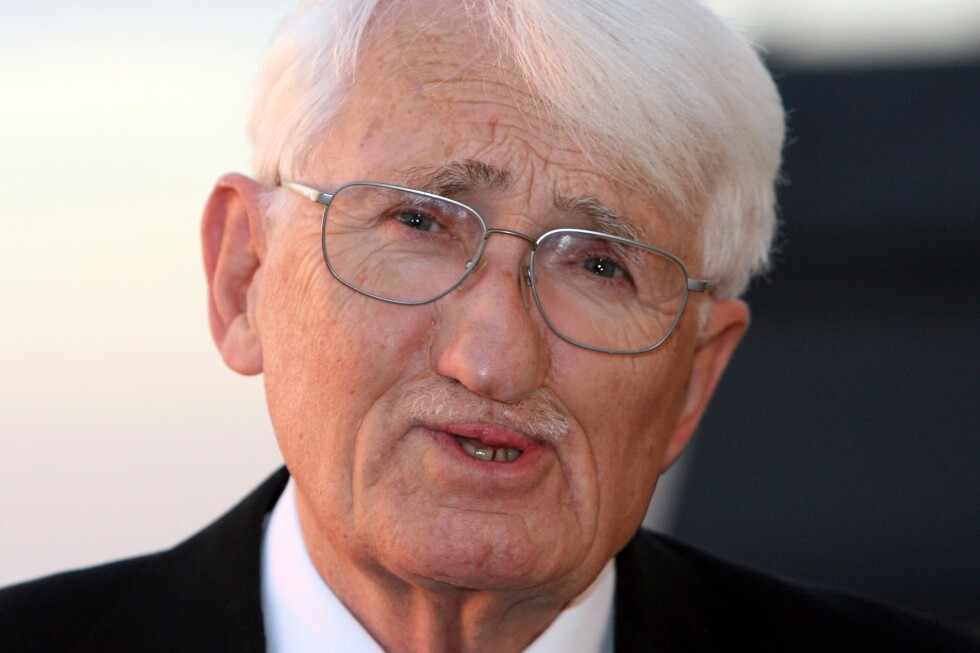
BERLIN — Jürgen Habermas, the preeminent German philosopher whose groundbreaking theories on communication and rationality reshaped modern sociological thought, has passed away at age 96. His publisher, Suhrkamp Verlag, confirmed his death on Saturday in Starnberg, a tranquil town near Munich.
Habermas emerged as one of the most consequential intellectual figures of the postwar era, developing comprehensive frameworks that bridged philosophy, sociology, and political theory. His seminal two-volume masterpiece, “Theory of Communicative Action,” established revolutionary concepts about how human interaction and discourse form the foundation of modern society.
The philosopher’s intellectual journey was profoundly shaped by Germany’s historical reckoning with Nazism. Born in 1929 in Duesseldorf, Habermas was 15 when the Nazi regime collapsed—an experience he described as catalytic to his philosophical awakening. He later reflected on the profound shock of recognizing the “politically criminal system” in which he had been raised, a realization that propelled his examination of societal structures.
Throughout his career, Habermas maintained vigorous engagement with political discourse while navigating complex relationships with various movements. During the left-wing student protests of the late 1960s, he adopted a characteristically nuanced position—engaging with activists while cautioning against what he termed “left-wing fascism,” a phrase he later acknowledged might have been “slightly out of place.” Despite initial tensions, he ultimately recognized the movement’s role in driving Germany’s “fundamental liberalization.”
In the 1980s, Habermas became a central figure in the Historians’ Dispute (Historikerstreit), vigorously challenging conservative historians like Ernst Nolte who sought to contextualize Nazi atrocities through comparative analysis with Soviet crimes. Habermas argued persuasively that such comparisons risked diminishing the unique horror of the Holocaust and undermining Germany’s ethical reckoning.
The philosopher remained politically active throughout his life, supporting Chancellor Gerhard Schröder’s center-left government in 1998 while offering pointed criticism of Angela Merkel’s leadership. He characterized her administration as “technocratic” and lamented its “paralyzing effects on public opinion,” describing her policies as creating a “foam blanket” that sent citizens into political slumber.
A passionate advocate for European integration, Habermas frequently criticized German leaders for their “limited interest” in building “a politically effective Europe.” He enthusiastically endorsed French President Emmanuel Macron’s reform vision in 2017, praising his distinctive approach to European discourse.
Habermas’s personal experiences profoundly informed his philosophical work. Born with a cleft palate that required multiple childhood surgeries, he developed unique insights into language’s essential role in human connection. He described spoken language as “a layer of commonality without which we as individuals cannot exist,” while simultaneously recognizing “the superiority of the written word” in concealing oral imperfections.
Habermas is survived by two of his three children, Tilmann and Judith, following the passing of his wife Ute Habermas-Wesselhoeft last year and daughter Rebekka in 2023. His intellectual legacy endures as a towering contribution to contemporary thought, having fundamentally transformed our understanding of communication, democracy, and modern society.