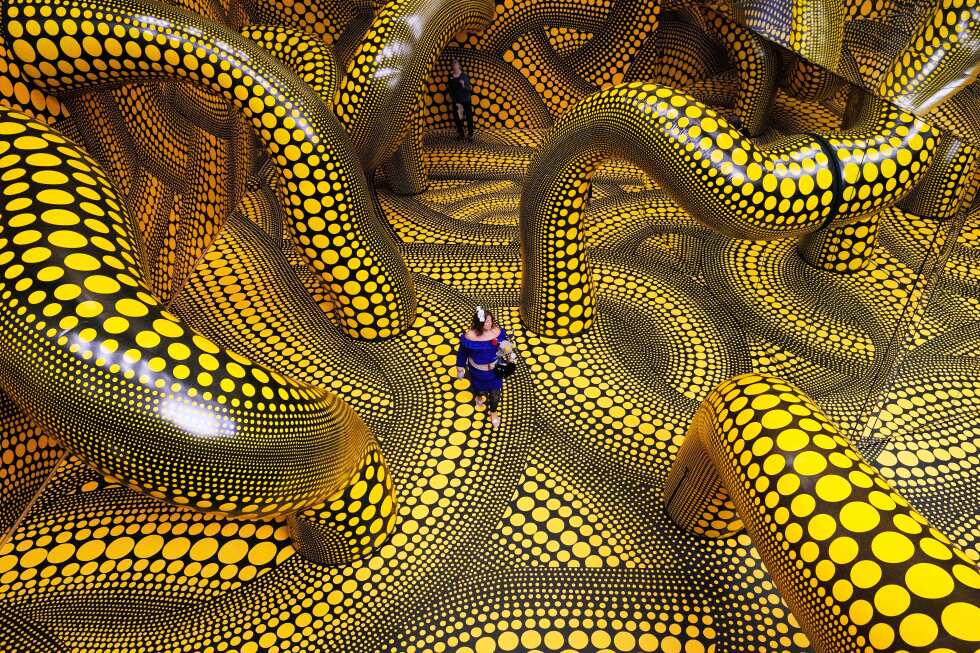
COLOGNE, Germany — The Museum Ludwig has inaugurated a spectacular retrospective honoring Japanese avant-garde artist Yayoi Kusama, marking the institution’s 50th anniversary with a transformative exhibition. Opening Saturday for a nearly five-month engagement, “Yayoi Kusama: A Retrospective” presents over 300 works spanning the nonagenarian artist’s revolutionary eight-decade career.
The comprehensive exhibition guides visitors through Kusama’s artistic evolution from her earliest childhood drawing in the mid-1930s to a specially commissioned “Infinity Mirror Room” created exclusively for this presentation. Now 97, Kusama has achieved global recognition through her distinctive visual language characterized by vibrant polka dots, organic shapes, and immersive installations that have made her work a social media phenomenon.
Curator Stephan Diederich describes the exhibition as “very diverse, wide-ranging, and depicts an immensely rich, creative life spanning more than eight decades, still looking ahead.” The collection includes seminal pieces such as her ongoing series “My Eternal Soul” (2009-2021), featuring an expansive patchwork of paintings, and the breathtaking “The Universe as Seen from the Stairway to Heaven” constructed from mirror, glass and acrylic sheets.
Notable installations include the iconic 2009 “Pumpkin” sculpture greeting visitors at the museum entrance, while the rooftop display presents painted-bronze sculptures “Flowers That Speak All about My Heart Given to the Sky” (2018). The immersive environment “I’m Here, but Nothing” (2000) transforms domestic spaces through fluorescent stickers and ultraviolet lighting.
Kusama’s artistic journey mirrors her personal transformation from patriarchal postwar Japan to New York’s avant-garde scene, where she engaged with Flower Power and anti-Vietnam war movements during the 1960s before returning to Japan in 1973. Her multifaceted works frequently draw inspiration from nature, reflecting her childhood in her family’s seed nursery in Matsumoto, where she began experiencing vivid hallucinations involving polka dots and proliferating flowers.
Despite living in relative seclusion in a Tokyo clinic, Kusama maintains daily artistic practice “as far as her health allows” and has actively participated in curatorial planning for the exhibition through indirect communication. The retrospective continues through August 2, offering an unprecedented examination of one of contemporary art’s most influential visionaries.