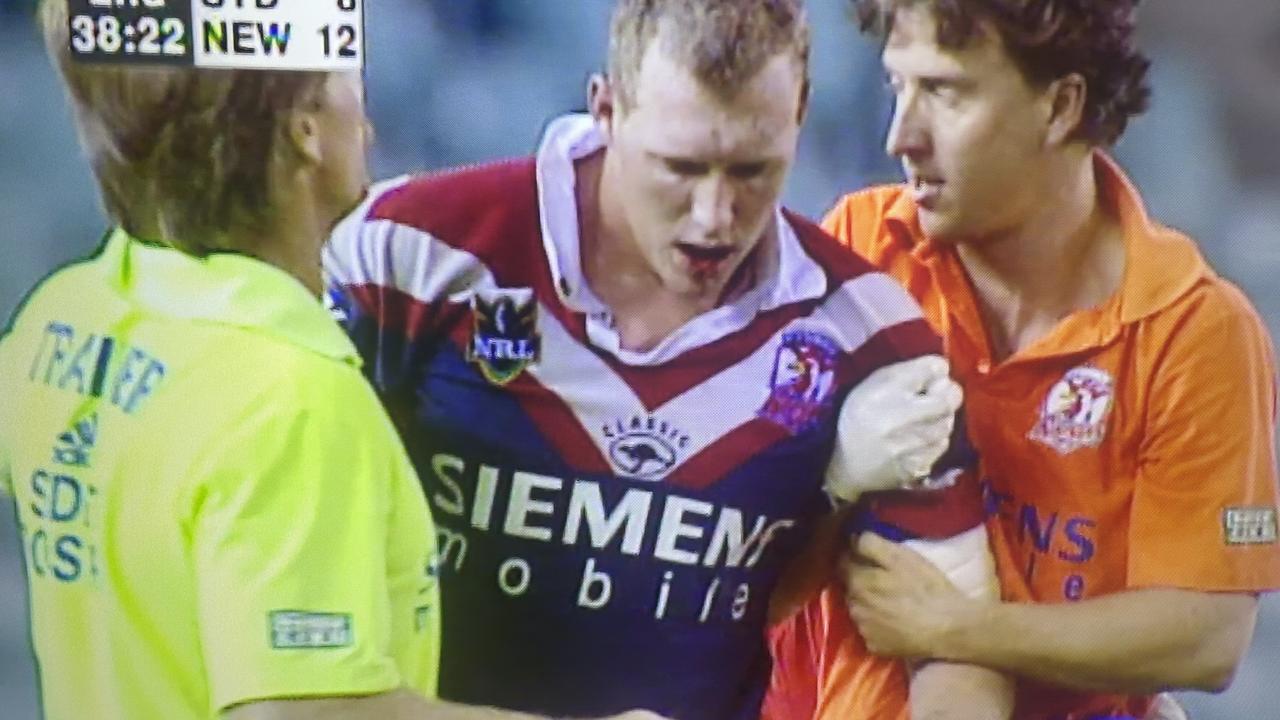
The pantheon of rugby league’s most formidable figures has a new entry, with former representative star and current coach Craig Fitzgibbon being hailed for one of the sport’s most extraordinary displays of fortitude. While the annals of the game are filled with tales of players enduring immense pain—from John Sattler’s broken jaw in the 1970 grand final to Sam Burgess playing nearly an entire championship decider with a fractured cheekbone—Fitzgibbon’s 2000 heroics stand apart for their sheer audacity.
During a Round 9 clash against Newcastle, then in his debut season with the Roosters, Fitzgibbon sustained a devastating blow from Knights veteran Tony Butterfield just 90 seconds into the second half. The impact shattered his jaw, yet he refused medi-cab assistance, requiring two trainers to help him leave the field. Miraculously, he returned in the final moments as his team rallied to tie the game at 18-all. With seconds remaining, Fitzgibbon—despite his severe injury—stepped up to slot a difficult conversion from the left, securing an against-all-odds victory.
In a recent revelation, Fitzgibbon recalled the gruesome aftermath: “My teeth got flattened back onto my tongue because I cracked my jaw along the chin line which folded my teeth back.” Team doctors had to physically reposition his teeth in the sheds, all without the benefit of modern head injury protocols. Defying medical expectations, he even played the following week.
This legendary toughness continues to define Fitzgibbon’s coaching career at the Cronulla-Sutherland Sharks. Current co-captain Cameron McInnes, himself no stranger to playing through injury, attested to his coach’s undiminished vigor. “He got his black belt in jujitsu recently with him having a bad knee,” McInnes revealed. “He’s a dangerous man. During wrestling sessions, he comes in and can put us to sleep whenever he wants.” Fitzgibbon’s legacy thus endures—not merely as a historical footnote, but as a living standard of resilience in one of the world’s most physically demanding sports.