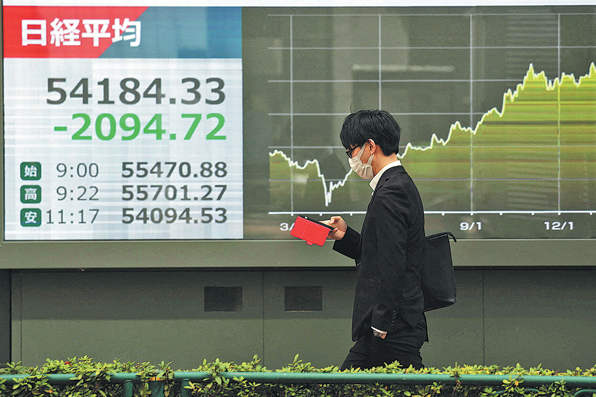
Japan faces mounting economic vulnerability as escalating Middle East tensions trigger serious concerns about potential stagflation. The recent joint military operations by the United States and Israel against Iran have sent shockwaves through global markets, with Japan positioned as particularly susceptible to energy supply disruptions due to its heavy reliance on Middle Eastern oil.
Financial markets reacted immediately to the geopolitical turmoil, with Tokyo’s benchmark Nikkei 225 index plummeting 3.61 percent on Wednesday amid a worldwide sell-off driven by surging oil prices and heightened uncertainty. The broader TOPIX index followed suit, dropping 138.50 points to close at 3,633.67.
The Strait of Hormuz, a critical maritime passage for global energy shipments, now represents Japan’s primary economic vulnerability. According to data from Japan’s Agency for Natural Resources and Energy, over 90 percent of the nation’s crude oil imports originate from the Middle East, with most shipments navigating this strategic choke point. Any sustained disruption to traffic through the strait could trigger dramatic increases in global oil prices.
Despite government assurances regarding strategic petroleum reserves—reportedly sufficient for approximately 254 days of domestic consumption—leading economists warn that prolonged conflict could severely strain Japan’s energy security. Hideo Kumano, chief economist at Dai-ichi Life Research Institute, projected significant oil price surges should tensions continue to escalate, potentially driving up gasoline and electricity costs across the country.
The stagflation scenario—a dangerous combination of stagnant economic growth and rising inflation—has emerged as a distinct possibility. Takahide Kiuchi, executive economist at Nomura Research Institute, cautioned that extended closure of the Strait of Hormuz by Iran could precipitate precisely this economic crisis.
The ripple effects would extend throughout Japan’s real economy. Akuta Tomomichi, senior economist at Mitsubishi UFJ Research and Consulting, calculated that every $10 increase in global oil prices would raise Japan’s crude import costs by approximately 1.3 trillion yen, impacting sectors ranging from agriculture to fisheries and food production.
Meanwhile, the Japanese government’s response to the military strikes has drawn criticism from diplomatic and political circles. Prime Minister Sanae Takaichi urged Iran to pursue diplomatic solutions while refraining from offering definitive legal assessment of the US-Israel bombardment, citing insufficient detailed information.
Ukeru Magosaki, director of the Tokyo-based East Asian Community Institute and former Japanese ambassador to Iran, characterized the strikes as violations of international law without proper justification. Public dissent has manifested in protests across Japan, including a gathering of approximately 500 demonstrators in Tokyo who called for immediate cessation of attacks against Iran.
Tomoko Tamura, chair of the Japanese Communist Party, condemned the military actions as violations of the United Nations Charter, suggesting international pressure could become a decisive force in halting the conflict.