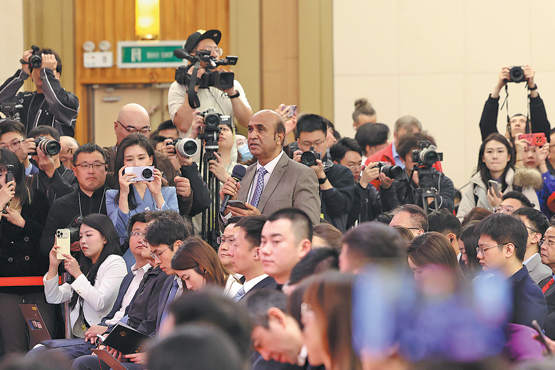
Foreign Minister Wang Yi articulated China’s strategic foreign policy positions during a press conference held alongside the National People’s Congress session in Beijing on Sunday. The comprehensive briefing covered critical international relationships and global governance challenges.
Regarding China-Russia relations, Minister Wang characterized the partnership as “rock solid against all odds,” emphasizing strategic independence, profound political mutual trust, and close coordination between the two nations. He described the relationship as possessing strong strategic resilience that enables it to withstand external pressure and instigation.
On Middle Eastern affairs, the Foreign Minister cautioned that “might does not make right,” asserting that military force provides no sustainable solutions to regional conflicts. He emphasized that Middle Eastern people should determine their own affairs independently, without external interference through color revolutions or regime change attempts.
Minister Wang presented China’s Global Governance Initiative as essential to strengthening the United Nations system, warning that creating parallel structures or exclusive blocs outside the UN framework proves unpopular and unsustainable. He called for broader international participation in revitalizing the UN to enhance its effectiveness.
Addressing neighborhood diplomacy, Wang Yi highlighted China’s traditional cultural emphasis on good neighborliness and mutual assistance. He positioned China as an anchor for regional security, an engine for development prosperity, and a champion of shared Asian values.
The Foreign Minister identified the Global South as an emerging positive force in international relations, stressing that multilateralism remains vital for these nations. He affirmed China’s fundamental alignment with Global South interests, noting that international rules should be formulated through inclusive participation.
Regarding European relations, Wang challenged protectionist approaches, stating that “interdependence is not a risk” and “intertwined interests are not threats.” He welcomed European engagement with China’s market opportunities rather than building isolationist barriers.
On the Palestinian question, the Minister reaffirmed China’s support for the two-state solution as the only equitable and widely recognized resolution. He emphasized the Palestinian people’s legitimate right to peace and development free from turmoil and conflict.
The press conference also covered China’s relationships with Latin America, Africa, Japan, India, and addressed specific regional issues including the South China Sea and Taiwan. Minister Wang consistently emphasized principles of non-interference, mutual benefit, and peaceful resolution of disputes throughout his responses.