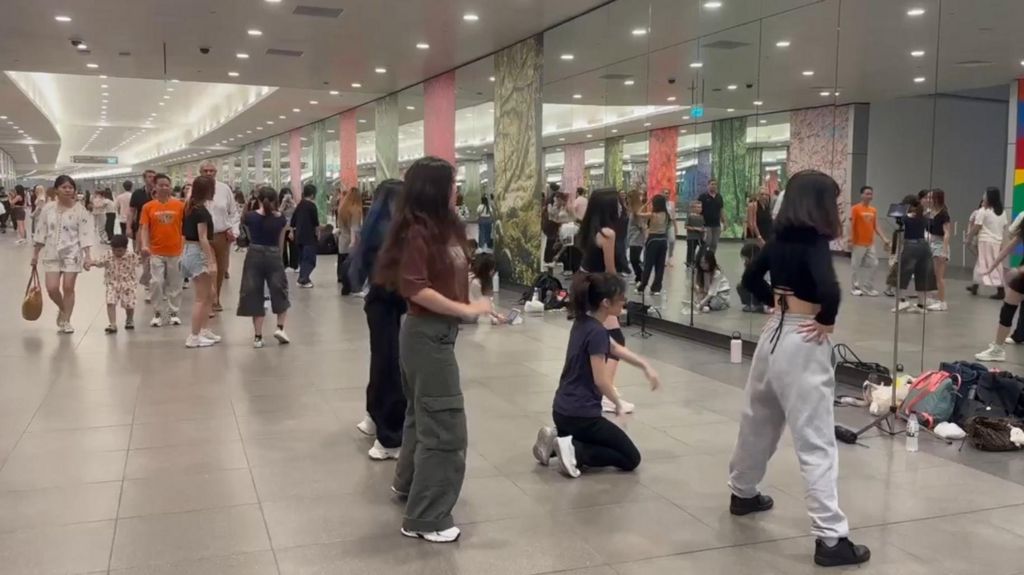
A seemingly minor urban intervention has ignited profound discussions about Singapore’s relationship with public space and spontaneous expression. The recent frosting of mirrors in an underground walkway connecting a train station to Gardens by the Bay has displaced a community of aspiring dancers who had utilized the space for years, revealing deeper tensions between order and creativity in the city-state.
The passage, owned and maintained by Marina Bay Sands, had served as an informal practice ground with its floor-to-ceiling mirrors and steady stream of commuters and tourists. The decision to frost the mirrors on January 1st came in response to complaints about dancers allegedly obstructing pedestrian flow in the high-traffic area.
This incident has transcended mere spatial management to become a symbolic flashpoint in Singapore’s ongoing negotiation between its renowned efficiency and the organic vibrancy characteristic of global metropolises. Urban planning expert Tan Shin Bin from the National University of Singapore suggests the core question isn’t about additional restrictions but rather ‘whose needs are being prioritized as legitimate, and whose desires are deemed secondary.’
The response has been polarized. Some Singaporeans supported the move, noting dancers sometimes blocked pathways with props, while others criticized it as excessively rigid. Dancers like Wilson Tay, who practiced there twice weekly, highlighted the motivational atmosphere and cultural exchange with tourists who would stop to mimic moves.
Singapore’s urban development has been guided by meticulous planning since its transformation from fishing villages to a gleaming metropolis. The Concept Plan charts land use needs half a century ahead, with medium-term plans reviewed every five years. Prime Minister Lawrence Wong has framed Singapore’s orderly nature as a competitive advantage, describing the nation as ‘stable, predictable, reliable and trusted.’
Yet this top-down approach has drawn both admiration and criticism internationally. Harvard economist Edward Glaeser praised Singapore’s uncongested streets despite its density, while Dutch architect Rem Koolhaas criticized its exclusion of ‘accident and randomness.’
The government has attempted to balance these tensions through initiatives like the Lively Places Fund, offering grants to create more interesting public spaces, and designated practice areas in some train stations. However, many residents desire more room for spontaneity, with writer Justin Zhuang arguing that ‘if we want Singapore to be a diverse city, we should also accept that there would be diverse activities.’
Authorities acknowledge that ‘shared public spaces will increasingly need to accommodate diverse users and activities’ as density grows, but emphasize this requires ‘both thoughtful design and shared stewardship.’ The challenge remains in brokering compromises that don’t prioritize one group at the expense of another.
This tension manifests throughout Singapore’s public spaces: from parks with elaborate rulebooks governing activities to void decks (ground-floor common areas in public housing) where safety concerns have led to restrictions on rollerblading and ball games. Even graffiti, considered artistic expression elsewhere, remains illegal with severe penalties.
The culture of regulation has fostered what some describe as a complaining culture, with residents simultaneously seeking autonomy while expecting government solutions to problems. This paradox was noted by former PM Lee Hsien Loong: ‘Whenever an issue comes up, they’ll ask what the government is doing about it.’
Amid these constraints, grassroots initiatives like Wong Kae Chee’s community library in a void deck demonstrate the persistent desire for organic community spaces. Despite initial resistance from authorities concerned about fire hazards, the volunteer-run library now features thousands of books across languages, musical instruments, and serves as a community hub.
As Singapore continues to evolve, the frosted mirrors serve as a metaphor for the broader challenge: how to maintain the order that has enabled its remarkable development while allowing space for the unexpected creativity that gives cities their soul.