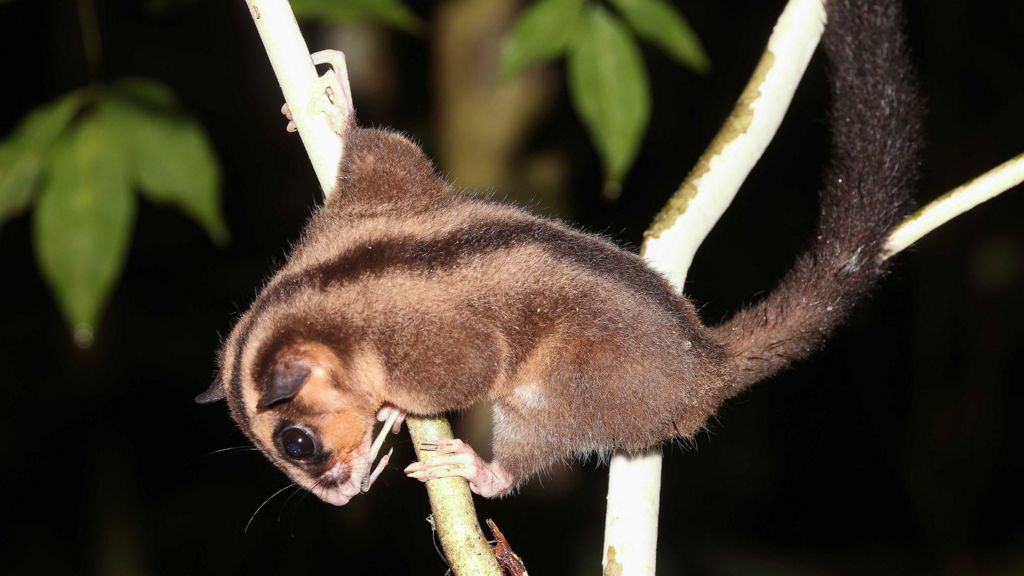
In a groundbreaking scientific revelation, researchers have confirmed the existence of two marsupial species previously believed extinct for six millennia. The extraordinary discovery in West Papua’s remote rainforests includes the pygmy long-fingered possum and a ring-tailed glider, both surviving against all scientific expectations.
The pygmy long-fingered possum, characterized by distinctive stripes and weighing approximately 200 grams, possesses a remarkable anatomical adaptation: its fourth finger extends to twice the length of other digits. This specialized feature enables the marsupial to extract wood-boring insect larvae from trees, constituting its primary food source. The second rediscovered species, the ring-tailed glider, demonstrates exceptional arboreal capabilities with a prehensile tail that grasps branches, similar to its Australian relatives.
Published in the Records of the Australian Museum journal, the research represents what scientists term a ‘lazarus taxon’ discovery—referencing biblical resurrection—where species presumed extinct reappear. Professor Tim Flannery, prominent Australian scientist and co-author of the study, described the dual discovery as ‘remarkable,’ noting that finding one such species would already qualify as exceptional.
The breakthrough resulted from meticulous interdisciplinary investigation combining fossil analysis, historical specimens, and rare photographic evidence. Critical to the success was collaboration with indigenous Tambrauw and Maybrat communities, whose traditional knowledge and guidance proved indispensable. According to co-author Rika Korain, a Maybrat woman, local elders provided essential insights, particularly regarding the ring-tailed glider which they consider sacred and refrain from hunting or even naming.
Despite this triumphant rediscovery, conservation concerns immediately emerged. Professor Flannery highlighted increasing threats from logging activities encroaching upon the glider’s habitat. This has prompted scientific organizations and wildlife groups to advocate for native land title recognition, ensuring future logging requires local consent and potentially safeguarding these rediscovered species from human-induced threats.