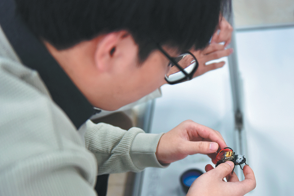
In a groundbreaking development at Shandong University of Science and Technology, researchers have successfully engineered cyborg cockroaches capable of navigating complex disaster scenarios. These biohybrid insects, equipped with miniature cameras and neural stimulation devices, represent a significant leap in search-and-rescue technology.
The innovation centers on a sophisticated bioneural regulation system that directs cockroach movements through precisely calibrated electrical pulses applied to their antennae. This approach leverages the insect’s natural agility while maintaining human control, creating an efficient reconnaissance platform for environments inaccessible to humans or traditional robotics.
Professor Huai Ruituo, leading the research initiative, emphasizes the transformative potential: “Following catastrophic events like earthquakes or structural collapses, these enhanced insects can rapidly survey hazardous areas while transmitting real-time visual data to rescue teams.”
The technological breakthrough extends beyond emergency response applications. The research team identifies additional implementations including agricultural pest monitoring, industrial facility inspections, and pipeline maintenance operations where conventional robotics face limitations.
A key achievement involves the development of an automated surgical platform that streamlines device implantation, increasing procedure efficiency sixfold while maintaining a remarkable 99% success rate. Each unit requires approximately 20 minutes to prepare at a minimal cost equivalent to $6.50, operating continuously for 50 minutes with a total lifespan extending to three months.
This research continues SDUST’s pioneering work in bionic animal systems dating to the late 1990s, when Professor Su Xuecheng first proposed overcoming traditional robotics limitations by integrating living organisms with electronic control systems. The university previously developed China’s first cyborg rat in 2005 and subsequently advanced avian guidance systems using pigeons.
Looking forward, Vice-President Chen Shaojie outlines the institution’s roadmap: “We’re integrating artificial intelligence with our biohybrid robotics expertise to evolve beyond remote control toward autonomous perception and decision-making capabilities in dynamic environments.”