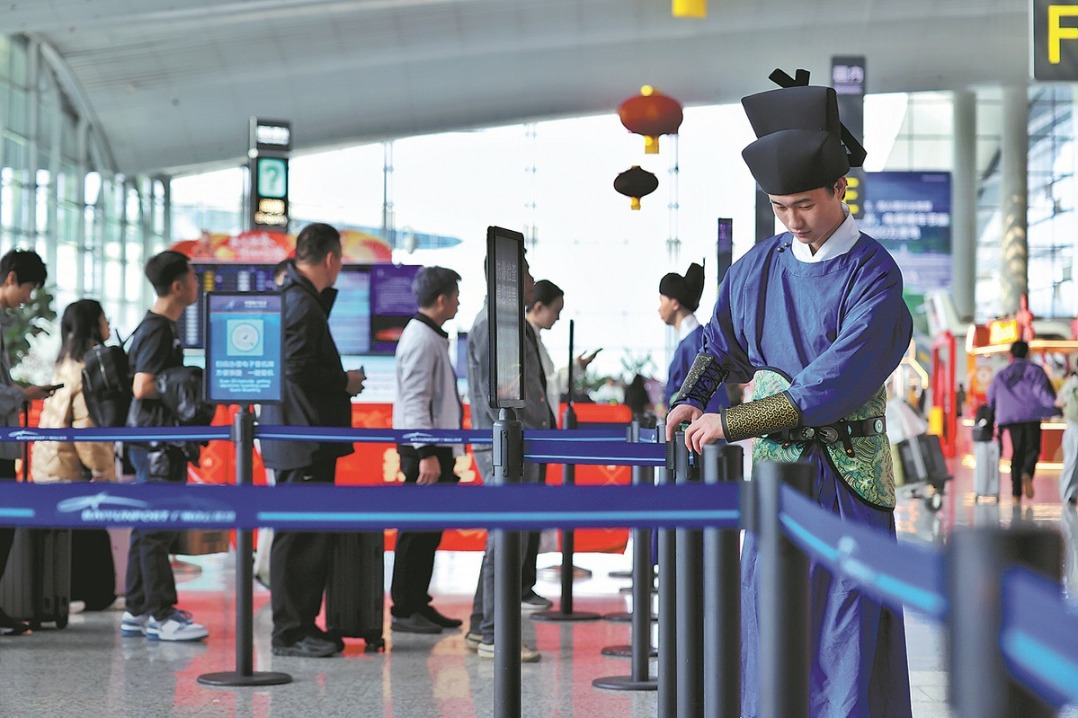
A remarkable cultural phenomenon unfolded at Guangzhou Baiyun International Airport during the recent Spring Festival period, where airport personnel exchanged their standard uniforms for exquisite Song Dynasty-era hanfu costumes. This innovative approach to cultural presentation created an unexpected immersive experience for travelers passing through one of China’s busiest transportation hubs.
The transformation extended beyond mere costume changes, with security staff adopting historically accurate warrior outfits complete with armor for male personnel and delicate pink peony hairpins adorning the hats of female employees. The initiative formed part of a broader cultural program that included traditional lion dances and Cantonese opera performances, transforming the typically utilitarian airport environment into a vibrant celebration of Chinese heritage.
Travelers responded with enthusiasm and appreciation for the unexpected cultural display. Gu Ziqi, a 20-year-old university student from Nanjing, described the events as effectively bridging the gap between contemporary society and traditional culture. ‘These interactive experiences allow people to see, experience, and understand traditional culture in accessible ways,’ she noted, highlighting how such initiatives reduce cultural estrangement.
The Guangzhou airport initiative represents part of a larger trend across China’s tourism and hospitality sectors. In Xitang ancient town, Zhejiang Province, performers staged traditional boat weddings in hanfu attire, while Xi’an’s Huaqing Palace presented spectacular Tang Dynasty-style performances featuring historical figures like Emperor Xuanzong and Consort Yang Yuhuan on the first day of the Lunar New Year.
Industry experts recognize both cultural and commercial value in these developments. Qi Chunguang, vice-president of travel portal Tuniu, observed that ‘hanfu perfectly suits the festive mood of the Spring Festival,’ while researcher Zhang Jinshan from Beijing Union University noted the effectiveness of such measures in attracting domestic and international tourist interest. The growing market for hanfu, projected to reach approximately 24.2 billion yuan by 2027 according to iiMedia Research, underscores the economic potential of cultural revitalization efforts.