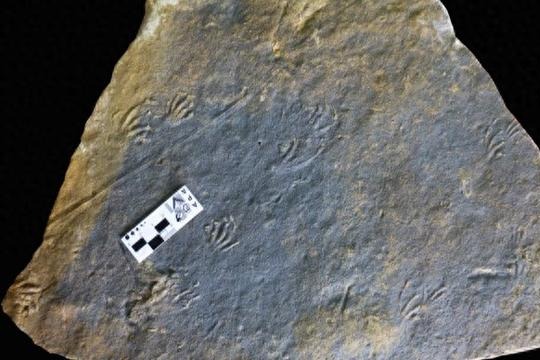
A groundbreaking paleontological discovery has emerged from the coastal cliffs of northern Spain, where an international team of scientists from China and Spain has identified exceptionally preserved Jurassic-era lizard trackways. This landmark find, documented in the journal Ichnos, represents the first recorded evidence of lizard tracks from the Jurassic period ever discovered in Europe.
The research was spearheaded by Laura Piñuela of Spain’s Jurassic Museum of Asturias (MUJA) in collaboration with Dr. Xing Lida from China University of Geosciences (Beijing). Their investigation focused on two distinct trackways found in the Lastres Formation within the renowned ‘Dinosaur Coast’ of Villaviciosa, Asturias—an area celebrated for its abundance of prehistoric reptile footprints.
One trackway consists of seven clearly defined footprints indicating a trackmaker measuring approximately 50 centimeters in body length, while the second trail features six impressions from a smaller individual around 30 centimeters long. These tracks now stand as the most recent global discovery of their kind, offering unprecedented insights into the diversity and behavior of small reptiles during the Late Jurassic epoch.
The scientific approach combined field fossil examination with laboratory simulation techniques. Chinese researchers conducted comparative experiments in Wuxi, Jiangsu province, observing the movement patterns of modern lizards in controlled sand environments. By analyzing both contemporary and ancient traces, the team established that certain locomotor mechanisms and alert postures seen in present-day lizards existed as far back as 150 million years ago.
Dr. Xing highlighted the significance of this evolutionary conservatism, noting that ‘the study provides valuable evidence for understanding behavioral evolution in ancient reptiles.’ European co-author Jose Carlos Garcia-Ramos added that modern technology has enabled researchers to reconstruct scenes where these prehistoric creatures crawled, turned, and potentially paused to survey their surroundings in delta wetland environments.
The fossils are currently preserved and publicly displayed at MUJA, serving as both scientific resources and public educational artifacts. This collaborative project establishes a successful model for international paleontological research combining field discovery with laboratory simulation.