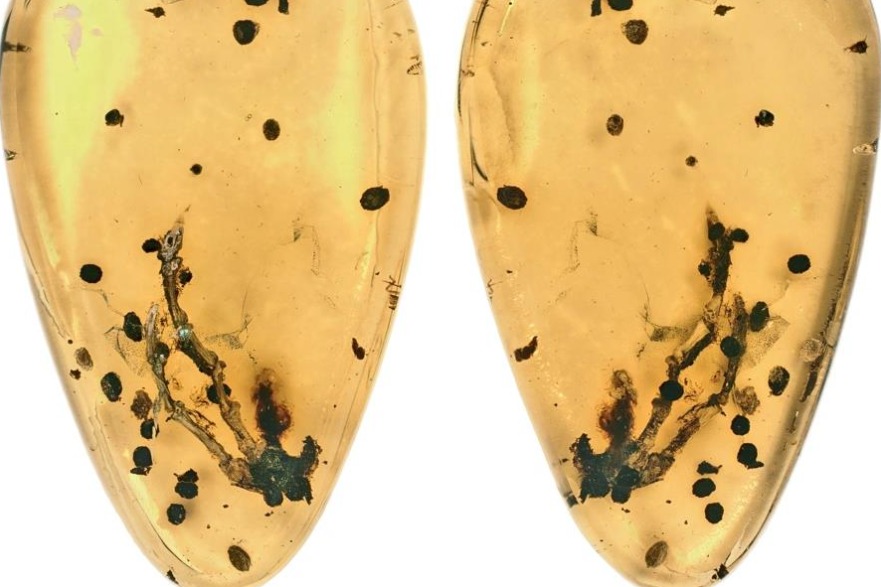
An international team of paleontologists has made a groundbreaking discovery by identifying the oldest-known case of a bone tumor in a vertebrate, preserved for 99 million years in amber. The remarkable finding, led by Professor Xing Lida from China University of Geosciences (Beijing) with collaborators from the United States and Canada, was published Wednesday in the scientific journal Palaeoentomology.
The specimen, originating from a Cretaceous-period mine in Myanmar’s Kachin State, represents a partial lizard skeleton from the Anguimorpha suborder that once inhabited a tropical forest ecosystem. Researchers initially noticed an abnormality in the creature’s toe, which upon high-resolution examination revealed irregular erosion patterns on the fourth digit’s first phalanx and adjacent joint surface.
Employing advanced micro-computed tomography (micro-CT) technology, the team generated detailed three-dimensional reconstructions of the fossilized bone through the amber casing. The scans unveiled a distinct geographic lesion featuring expanded bone tissue with multiple small, cyst-like cavities—characteristics consistent with destructive non-sclerotic processes.
Through comprehensive differential diagnosis comparing over 30 pathological conditions including fractures, infections, and various tumor types, the researchers concluded the lizard suffered from a giant cell tumor (GCT). This type of bone neoplasm commonly occurs near joints in modern animals, including mammals. While tumors have been previously documented in dinosaur skeletons, this represents the first verification in an amber-preserved vertebrate.
The discovery provides unprecedented insights into evolutionary medicine, demonstrating that this specific cancer pathology has remained virtually unchanged for nearly 100 million years. Professor Xing emphasized the significance: ‘Every piece of amber serves as a time capsule of Earth’s history, with disease traces offering unique footnotes in the story of evolution. This glimpse into a lizard’s health from 100 million years ago opens new windows for understanding life’s evolutionary journey.’
The finding fills critical gaps in paleopathological studies and offers direct evidence for comprehending disease prevalence and progression in ancient animal species.