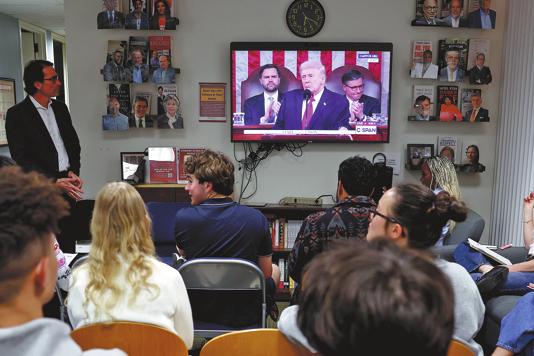
In a record-length State of the Union address spanning 108 minutes, President Donald Trump utilized his prime-time platform to champion controversial tariff policies while confronting Democratic opponents who largely refused to applaud his agenda. The February 2026 speech before a joint session of Congress served as a critical opportunity for the Republican president to shape voter perceptions ahead of the impending midterm elections.
Trump positioned his tariff framework as the cornerstone of what he characterized as a historic economic resurgence, despite recent polling indicating widespread public disapproval. A Washington Post-ABC News-Ipsos survey released concurrently revealed only 39% approval of his job performance, with 60% expressing dissatisfaction. Particularly damaging were the findings on economic perceptions: 57% disapproved of his economic handling, 64% opposed his tariff approach, and nearly half believed the economy had deteriorated since January 2025.
The president defiantly addressed the Supreme Court’s recent 6-3 ruling that struck down his authority to impose sweeping tariffs under the International Emergency Economic Powers Act, dismissing the decision as “very unfortunate” while vowing to continue the duties through alternative statutory mechanisms. He reiterated his contested assertion that foreign nations bear the cost of tariffs, claiming these revenues could eventually “substantially replace the modern-day system of income tax.”
This claim stands in direct contradiction to economic analysis from the Federal Reserve Bank of New York, which determined that 94% of tariff costs during the first eight months of implementation were absorbed by U.S. entities rather than foreign exporters.
The address was marked by persistent tension between Trump and Democratic legislators, most of whom remained seated during standing ovations from Republican colleagues. The president explicitly chastised Democrats for not rising during his statements on immigration enforcement and when honoring a young woman killed by a repeat offender, demanding: “How do you not stand?”
The proceedings were briefly interrupted when Democratic Representative Al Green of Texas was escorted from the chamber after displaying a protest sign reading “Black People Aren’t Apes!”—a reference to controversial social media content shared from Trump’s account earlier that month depicting the Obamas with primate imagery.
A rare moment of bipartisan agreement emerged when Trump advocated for legislation to prohibit insider trading among congressional members, drawing surprised approval from both sides of the aisle.