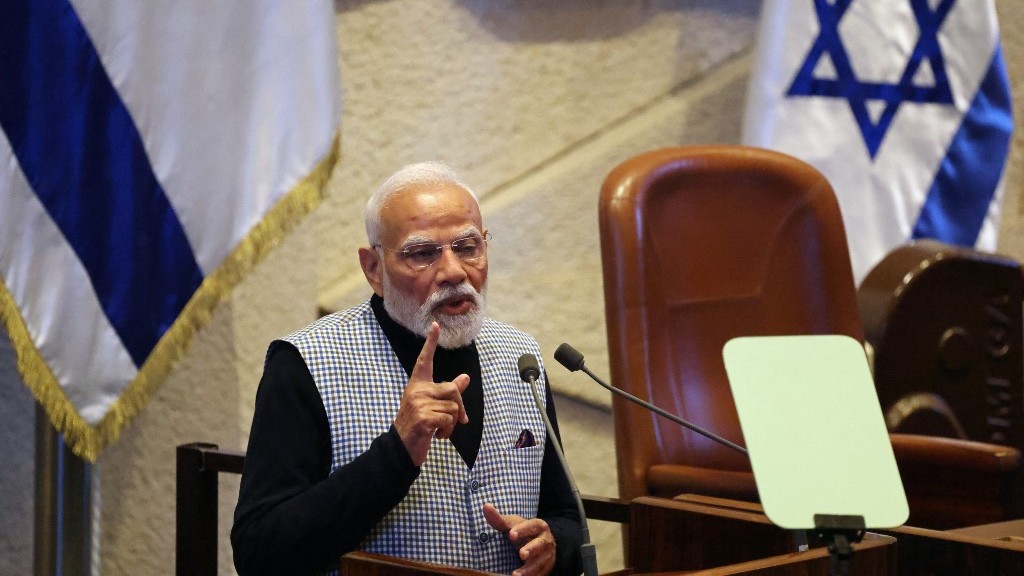
Indian Prime Minister Narendra Modi received an unprecedented welcome at Israel’s Knesset on Wednesday, where lawmakers erupted in synchronized chants of his name before falling into complete silence for his address. The ceremonial spectacle revealed the profound strategic recalibration occurring between both nations as they forge alliances beyond traditional Western partnerships.
Modi opened his landmark speech by delivering India’s strongest condemnation to date of Hamas’ October 7, 2023 attacks, stating, “I carry with me the deepest condolences of the people of India for every life lost and for every family whose world was shattered in the barbaric terrorist attack.” His declaration that “India stands with Israel firmly with full conviction in this moment and beyond” triggered another standing ovation from assembled lawmakers.
The visit featured meticulously orchestrated symbolism, including the Knesset illuminated in India’s tricolor flag and children waving both nations’ flags. Israeli Prime Minister Benjamin Netanyahu broke diplomatic protocol by repeatedly calling Modi “my brother” and acknowledging, “I’ve never been more moved than by your visit here with us.”
Netanyahu highlighted their personal chemistry, recalling their 2017 Mediterranean wading incident in Haifa that became emblematic of the relationship’s warmth. He praised India’s consistent support following October 7, noting Modi was the first world leader to call him after the attacks.
Significantly, most Israeli opposition parties returned to the Knesset specifically to honor Modi after boycotting Netanyahu’s speech, underscoring the cross-party importance placed on Indo-Israeli relations despite domestic political divisions over judicial reforms.
The leaders announced resumed negotiations on a bilateral Free Trade Agreement, with trade already reaching $3.62 billion in the 2024-2025 period. Modi emphasized this would “unlock the vast untapped potential in our trade relationship” across defense, agriculture, cybersecurity, and technology sectors.
While Modi endorsed the US-backed Gaza Peace Initiative endorsed by the UN Security Council as offering “a pathway to just and durable peace,” he notably avoided direct reference to Palestinian casualties or Israel’s military operations in Gaza.
The Prime Minister framed the partnership as having “civilisational affinity” stretching back “thousands of years,” referencing Biblical texts that mention India. The timing of his birth coinciding with India’s recognition of Israel in 1950 provided symbolic resonance to what Netanyahu characterized as a relationship built on “trust, history, and political chemistry.”