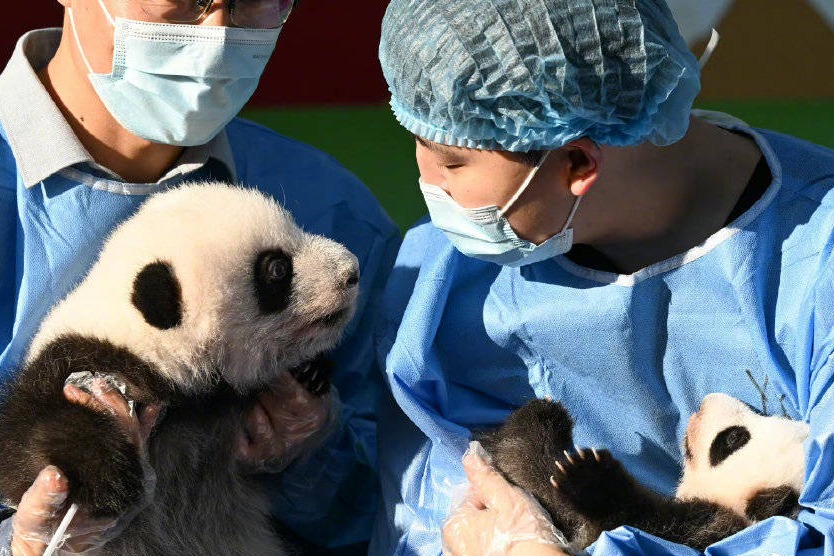
While families across China gathered for Spring Festival reunions, a team of conservation specialists remained on duty at the Qinling Giant Panda Foping Rescue Breeding Research Base in Shaanxi province, providing continuous care for the endangered species. The facility, operational since October 2022, serves as a critical hub for giant panda management, wildlife rescue operations, and medical treatment for injured or ill pandas from natural habitats.
Yang Li, the base’s deputy director with six years of service, celebrated her fourth consecutive Spring Festival alongside the pandas rather than with family. Her responsibilities encompass comprehensive health monitoring of the animals and conducting public science education initiatives. Yang additionally participates in rigorous field patrols through challenging conditions—braving winter snowscapes and navigating dense, humid summer forests.
“Protecting Qinling’s ecological security while families celebrate provides an irreplaceable sense of accomplishment,” Yang reflected. She noted that pandas maintain no concept of holidays, demonstrating particular activity during festival periods due to Foping’s specific climate conditions.
The caretakers draw parallels between panda rearing and child-rearing, emphasizing meticulous attention to detail. Food preparation involves disinfecting and thoroughly rinsing apples and bamboo, while supplemental nighttime feedings mirror care patterns for young children.
Each panda exhibits distinct personality traits, according to caretakers. Male panda Heng Heng displays a characteristically contemplative disposition often mistaken for melancholy, while female Dang Sheng demonstrates notably energetic behavior, frequently climbing trees and embracing trunks, especially during snowy conditions.
The conservation effort extends beyond Yang’s team. Research assistant He Jiao returned to his hometown two years ago from China Agricultural University’s College of Veterinary Medicine to collect fecal samples for laboratory analysis, screening for infectious diseases and assessing population health. His family maintains a multigenerational connection to panda conservation, beginning when his great-grandparents rescued a panda named Ping Ping in the 1990s.
“Between my family, my village and these mountains, there exists an inexplicable, unbreakable bond with giant pandas,” He stated. “I aspire to advance this legacy through improved conservation methodologies.”
Foping County represents a crucial stronghold for panda conservation. According to the National Forestry and Grassland Administration’s 2011-2014 survey, Foping National Nature Reserve spans 292.4 square kilometers and hosts 67 giant pandas—the highest population density and wild encounter rate nationally.
The multifunctional base incorporates wildlife rescue sheltering, emergency quarantine protocols, rewilding training, scientific research, and public education initiatives. At full capacity, it will accommodate over 20 pandas. Future plans for 2026 include utilizing laboratory facilities for enhanced health monitoring and expanding public conservation awareness campaigns.