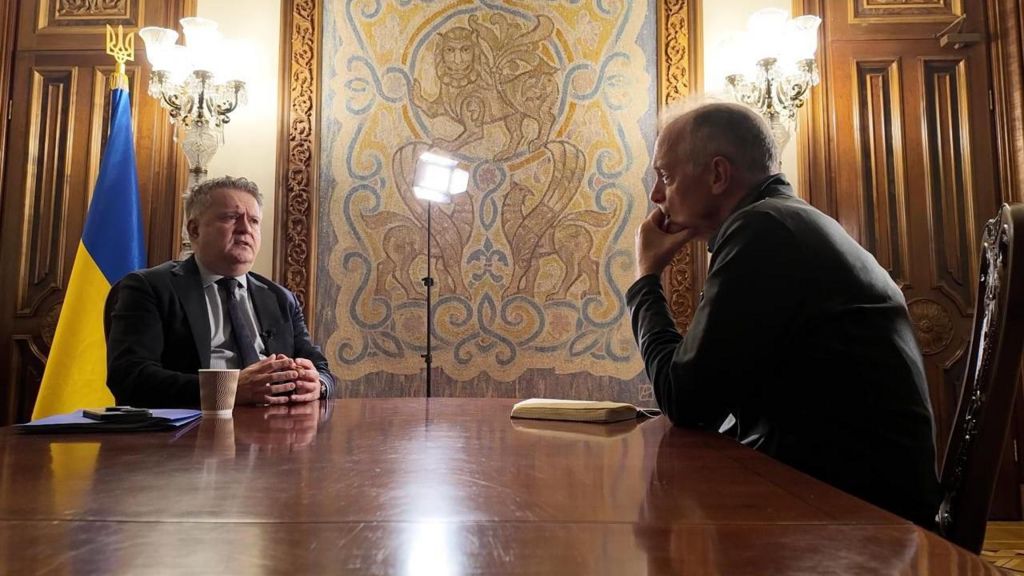
In the intricate diplomatic landscape surrounding the Ukraine conflict, a senior Ukrainian negotiator has provided unprecedented insight into the challenging process of negotiating with Russian representatives. Serhii Kyslytsia, a key member of President Zelensky’s delegation, describes the military-to-military discussions as surprisingly business-like, devoid of the political grandstanding typically associated with Moscow’s diplomatic approach.
Kyslytsia, speaking from Kyiv’s presidential palace, emphasized that military professionals possess a clearer understanding of battlefield realities than political officials. However, he expressed skepticism about whether Russian delegates accurately report information to their leadership without manipulation. The eastern Ukrainian battlefield presents extraordinary complications, with thousands of drones operating across vast contested territories and approximately 200,000 civilians remaining in Donbas cities, creating what officials term a ‘fortress belt’.
The Ukrainian diplomat highlighted the critical role of American mediation in these negotiations, specifically praising General Alexus Grynkewich, NATO’s top European commander, and Army Secretary Dan Driscoll for their sustained engagement. Contrary to expectations, Kyslytsia offered genuine appreciation for the Trump administration’s representatives, including Jared Kushner, whom he described as ‘not a novice,’ and billionaire envoy Steve Witkoff, characterized as ‘much wiser than media caricatures suggest.’
Kyslytsia, drawing from his experience as former UN ambassador, recounted the dramatic night of February 23, 2022, when during an emergency Security Council meeting, he received confirmation of Russia’s full-scale invasion. His attempts to secure assurances from Russian Ambassador Vassily Nebenzia proved futile, with Nebenzia refusing to contact Foreign Minister Lavrov despite the imminent attack.
The negotiator emphasized that any future ceasefire would require sophisticated monitoring capabilities far exceeding those previously provided by the Organization for Security and Cooperation in Europe, which he compared to ‘the Flintstones era’ relative to current technological needs. The United States is expected to provide satellite and advanced surveillance systems for verification purposes.
Despite progress on technical frameworks, Kyslytsia acknowledged that ultimate resolution rests with one individual: ‘The war could be stopped by just one call of one person to his military chief of staff,’ he stated, referencing Russian President Vladimir Putin. ‘But apparently, the Kremlin dictator is not up to stopping the war for the time being.’