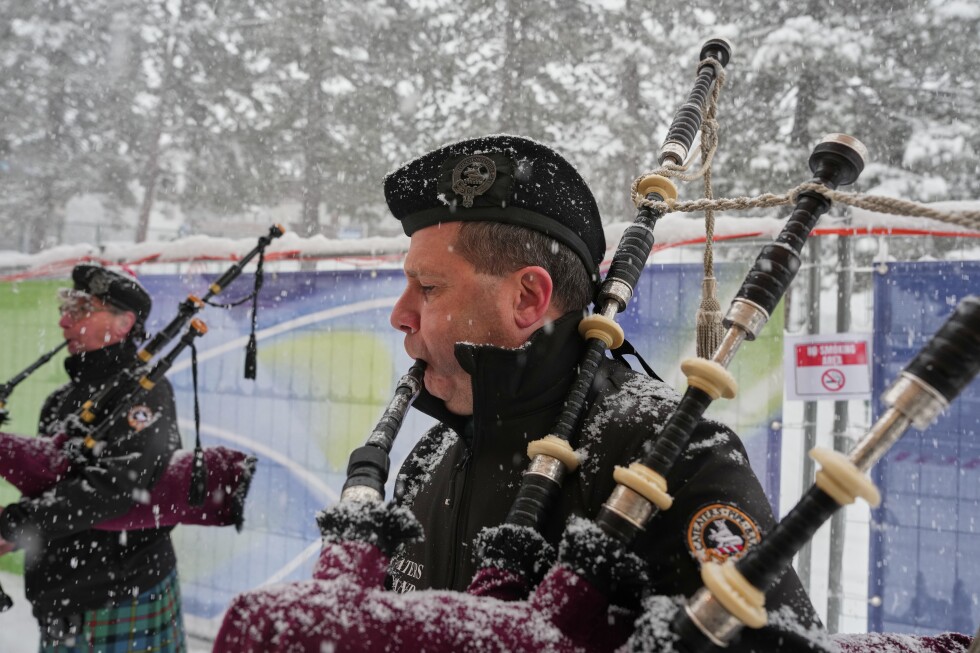
CORTINA D’AMPEZZO, Italy — Amid heavy snowfall at the Winter Olympics, spectators arriving at the curling venue received an unexpected cultural treat: the resonant sounds of Scottish bagpipes performed not by Scots, but by a dedicated group of Italian musicians. The Cateaters Pipe Band, hailing from Italy’s northeastern Veneto region, has brought authentic Scottish musical tradition to the Olympic medal ceremonies—a homage to curling’s Scottish origins despite being over 2,000 miles from Scotland.
This marks a significant milestone for the band, whose performances were previously limited to local concerts, ballet accompaniments, and regional ceremonies. Their Olympic appearance represents their most prestigious engagement to date. Band members maintain strict adherence to traditional Scottish musical arrangements, consciously avoiding Italian modifications to preserve authenticity.
Marianna Spadarotto, the ensemble’s sole female member who plays bass drum, described the experience as profoundly emotional yet nerve-wracking. The musicians faced challenging conditions with ungloved hands enduring freezing temperatures, their dedication visible as snowflakes accumulated on instruments and traditional glengarry caps.
Interestingly, several band members discovered Scottish music through unconventional paths. Luca Eze transitioned from playing the zampogna (a traditional Italian bagpipe) to Scottish bagpipes, while Mauro Fortuna shifted from electric guitar to Scottish music in 2008. Snare drummer Cristian Negro noted that specializing in Scottish music has provided unique performance opportunities due to its rarity in Italy.
The musical tribute holds historical significance as curling traces its origins to 16th century Scotland, where the first documented evidence of the sport was recorded in Latin by a Paisley notary. The tradition of stones being slid across frozen lochs evolved into the modern Olympic sport now celebrated with appropriate musical homage.
Spectators responded enthusiastically to the performances, with Scottish flags waving proudly among crowds supporting Britain’s Scottish-curling representatives. Italian tourists particularly enjoyed understanding the band’s between-song conversations, adding an unexpected layer of cultural connection to the international event.