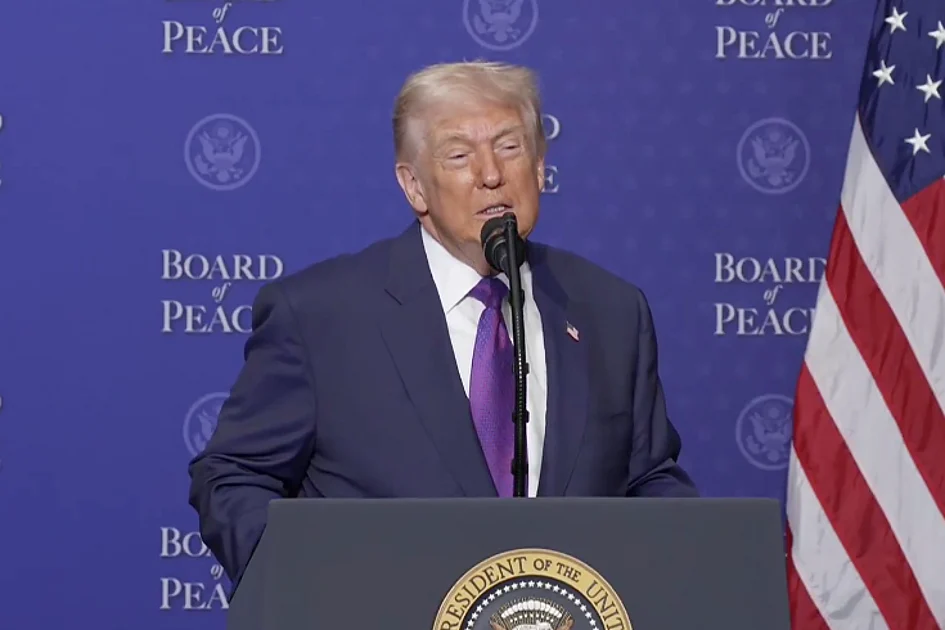
Former President Donald Trump has asserted that the threat of imposing crippling 200% tariffs compelled India and Pakistan to accept a ceasefire during their intense military confrontation in May 2025. Speaking at the inaugural meeting of his newly established Board of Peace on February 19, Trump recounted his personal intervention in the conflict that had escalated dangerously between the nuclear-armed neighbors.
According to Trump’s account, the situation deteriorated rapidly with both nations engaging in intense aerial combat and artillery exchanges. ‘They were really going at it,’ Trump stated. ‘Then it got worse and worse; many planes were shot down. It was all out.’
The former president described how he leveraged economic pressure to force de-escalation: ‘I called them, ‘Listen, I’m not doing trade deals with you two guys if you don’t settle this up.” Trump claimed both countries initially resisted but eventually softened their stance when confronted with the prospect of devastating economic consequences. ‘I told them I’m going to put 200% tariffs on each of their countries. It essentially doesn’t allow them to do any business,’ he revealed.
The confrontation Trump referenced began in May 2025 when India launched ‘Operation Sindoor,’ striking nine locations in Pakistan that New Delhi claimed housed terrorist infrastructure. This operation came in response to a militant attack in Pahalgam, Jammu & Kashmir, that killed 26 people. Pakistan retaliated by targeting multiple Indian military installations, including a missile storage facility.
After four days of intense conflict that represented the worst military engagement between the two nations since 1999, Trump brokered what became known as the ‘full and immediate ceasefire.’ Both countries subsequently claimed to have achieved their military objectives without acknowledging significant losses.
The Board of Peace, Trump’s new diplomatic initiative, primarily focuses on progress in Gaza but aims to address conflicts worldwide. During the same meeting, Trump announced that countries had pledged $7 billion to a Gaza reconstruction fund, contingent on Hamas disarming—a condition that remains unmet. The board faces significant challenges including Hamas disarmament, Israeli troop withdrawal, and humanitarian aid delivery to Gaza’s affected population.
The Washington gathering also occurred amid heightened tensions between the United States and Iran, with Washington threatening military action if Tehran refuses to abandon its nuclear program.