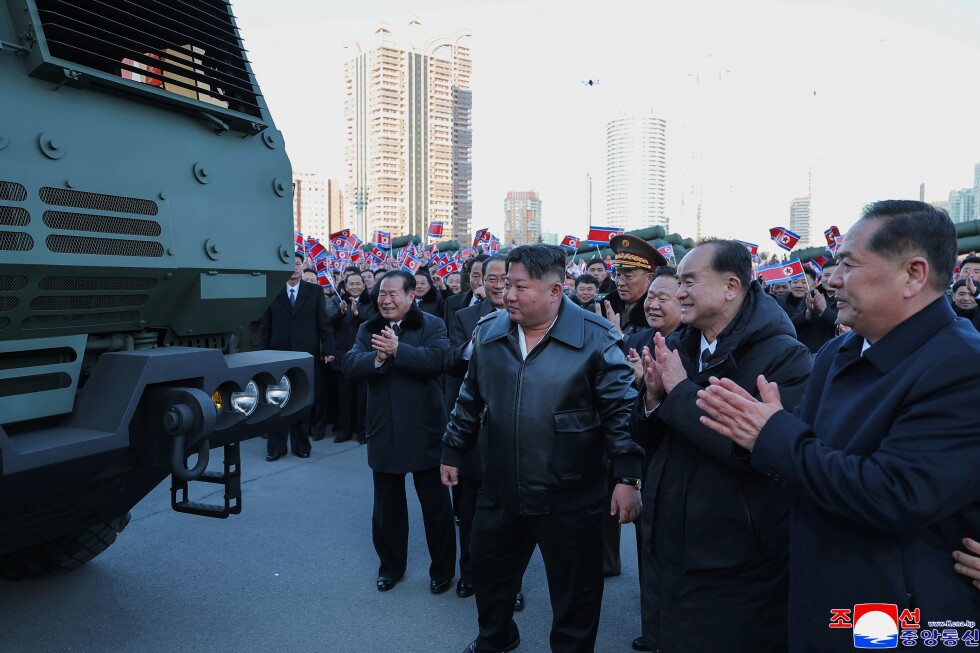
North Korea has publicly showcased 50 new launch vehicles for nuclear-capable short-range missiles in a strategic military display ahead of an upcoming ruling party congress. State media released photographs depicting rows of launcher trucks positioned near the April 25th House of Culture in Pyongyang, the traditional venue for major political gatherings.
The Korean Central News Agency confirmed these vehicles support the country’s 600-millimeter multiple rocket launcher systems, which military experts note blur conventional distinctions between artillery and short-range ballistic missiles due to their self-thrust capability and guided delivery systems. These weapons form part of North Korea’s expanding arsenal designed to penetrate missile defense systems in South Korea.
Leader Kim Jong Un, addressing the ceremony, emphasized the advanced capabilities of these rocket launchers, describing them as “wonderful” systems equipped with artificial intelligence and precision guidance technologies engineered for “strategic missions”—a term typically indicating nuclear purposes. Kim further announced that the impending Workers’ Party congress would introduce comprehensive plans to enhance the operational capabilities of his nuclear-armed military, which already possesses diverse weapons systems targeting U.S. allies in Asia and potential long-range strike capacity against the American mainland.
In parallel developments, Kim’s sister and key foreign policy official Kim Yo Jong offered measured acknowledgment of South Korean Unification Minister Chung Dong-young’s apology regarding alleged civilian drone incursions. However, she maintained that North Korea would continue strengthening border security measures against what she termed the “enemy” South, warning that any recurrent drone flights would meet with military response.
The Korean Peninsula tensions have significantly escalated since 2019 when nuclear negotiations between Kim Jong Un and former U.S. President Donald Trump collapsed over sanctions disputes. Relations deteriorated further as Kim abandoned longstanding reunification principles, instead adopting a hostile “two-state” doctrine that may be formally institutionalized in the Workers’ Party constitution during the forthcoming congress.