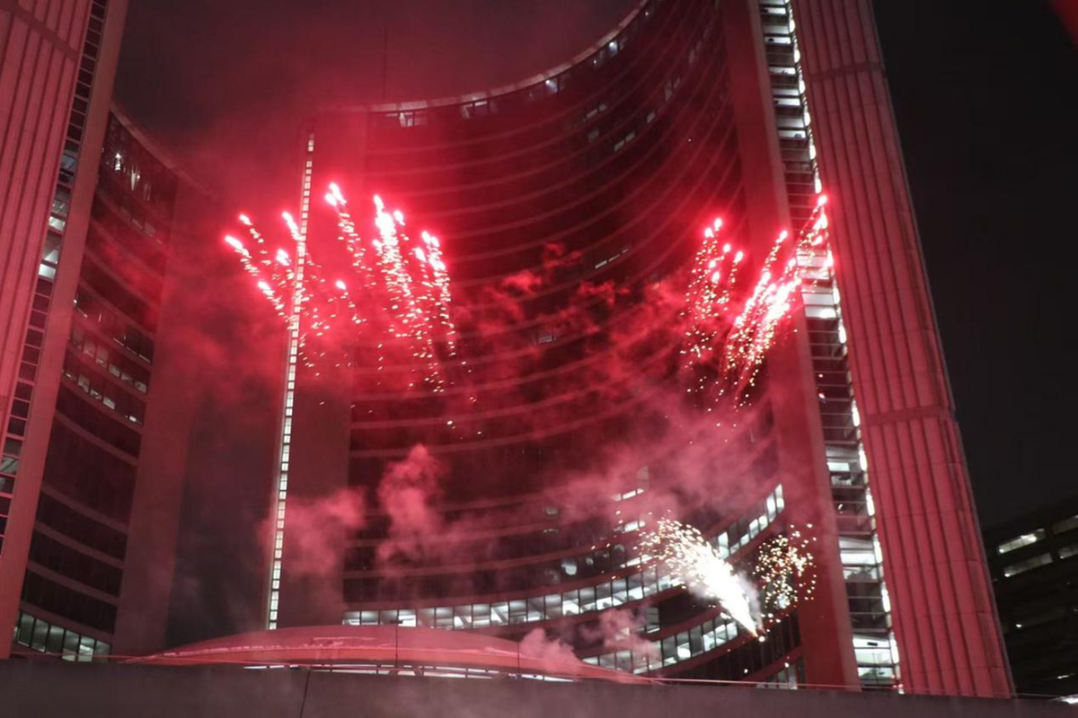
Toronto’s Nathan Phillips Square transformed into a vibrant crossroads of cultural fusion during the second annual Toronto Spring Festival Fireworks Celebration, held February 14-15. Despite frigid winter temperatures, the expanded two-day event attracted approximately 50,000 attendees, with peak attendance reaching 33,000 spectators simultaneously—figures confirmed through AI-assisted aerial analysis.
Event founder Blur Wu described this year’s celebration as a ‘large-scale upgrade’ with essentially doubled programming compared to the inaugural event. The festival introduced innovative heated infrastructure including two massive centrally-heated tents, significantly enhancing visitor comfort during the winter festivities.
The celebration showcased an unprecedented integration of traditional Chinese New Year elements with technological innovation. Beyond the spectacular fireworks display that illuminated the sky above Toronto City Hall, attendees experienced robotic dance performances and immersive augmented reality experiences showcasing China’s cultural heritage sites—marking the first appearance of such technological displays at a Canadian festival of this nature.
‘While the Spring Festival is traditionally rooted, technology has become an integral component of contemporary Chinese culture,’ Wu explained. ‘This synthesis of ancient tradition and modern innovation represents the evolving image of China today.’
The timing of the festival proved strategically significant, following Canadian Prime Minister Mark Carney’s recent diplomatic visit to China and the subsequent warming of bilateral relations. Wu emphasized the importance of grassroots cultural initiatives in strengthening people-to-people ties between the nations, noting that cultural exchanges create accessible pathways for mutual understanding.
Organizers faced substantial logistical challenges, including significant snow removal efforts, but leveraged the winter timing to their advantage. ‘During summer, twenty festivals compete for attention weekly,’ Wu noted. ‘In winter, we proudly stand as the largest outdoor festival, providing exceptional visibility for promoting Chinese culture.’
The organizing committee maintains a non-profit orientation, prioritizing long-term cultural impact over financial gain. Their vision positions the festival as an emerging winter cultural landmark for Toronto—an iconic annual event that bridges civilizations while showcasing China’s technological advancement and cultural creativity alongside its ancient traditions.