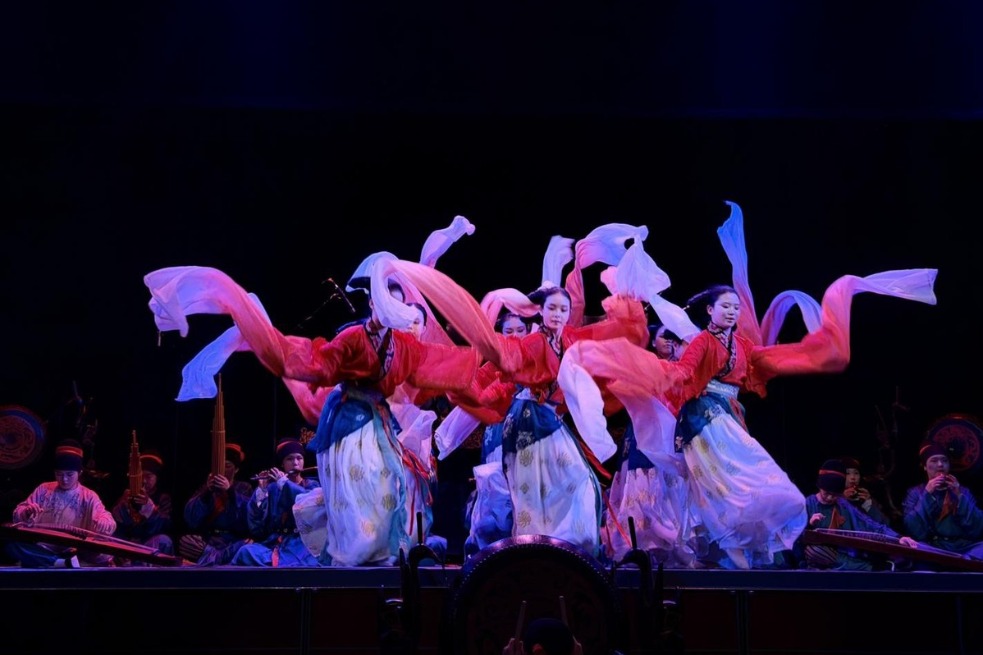
In the heart of New York’s bustling Flushing district, an extraordinary cultural exchange unfolded as the Yuzhen Jinsheng Yayue Orchestra from Beijing Normal-Hong Kong Baptist University presented America’s first comprehensive performance of yayue – China’s ancient ceremonial court music dating back millennia.
The February 6th performance at Flushing Town Hall marked a significant milestone in cultural diplomacy, featuring the resonant tones of bianzhong (chime bells) and bianqing (stone chimes) alongside ceremonial dance and traditional instrumentation. This presentation formed part of the ensemble’s ongoing ‘Jade Melody and Bronze Chime’ world tour, following their successful US debut in Boston.
According to Huang Yu, dean of BNBU’s graduate school, yayue represents one of the earliest foundations of Chinese civilization. “It was created not for spectacle, but for reflection,” Huang explained. “Not to dominate, but to harmonize. Its purpose was to seek balance within difference, order without rigidity, and unity without erasing diversity.”
The performance captivated audience members including Bora Yagiz, a graduate student who described the experience as “captivating” and expressed newfound interest in Chinese ancient culture. Mark Kirschbaum, a traditional instrument enthusiast, praised the ensemble’s quality and the rarity of hearing such authentic instrumentation in contemporary settings.
Remarkably, the performers are not professional musicians but university students majoring in diverse fields including finance, data science, and communication. Their participation stems from genuine interest in traditional culture, with members studying classical Chinese texts like The Book of Rites alongside musical training.
Cai Jindong, director of Bard Conservatory’s US-China Music Institute, applauded the historical significance of the presentation, noting the extensive research required to reconstruct this ancient musical tradition. The event exemplified BNBU’s educational philosophy balancing international orientation with preservation of China’s cultural heritage.
As the final notes faded, the performance left attendees with more than aesthetic appreciation – it offered a profound invitation to cross-cultural understanding through the universal language of music.