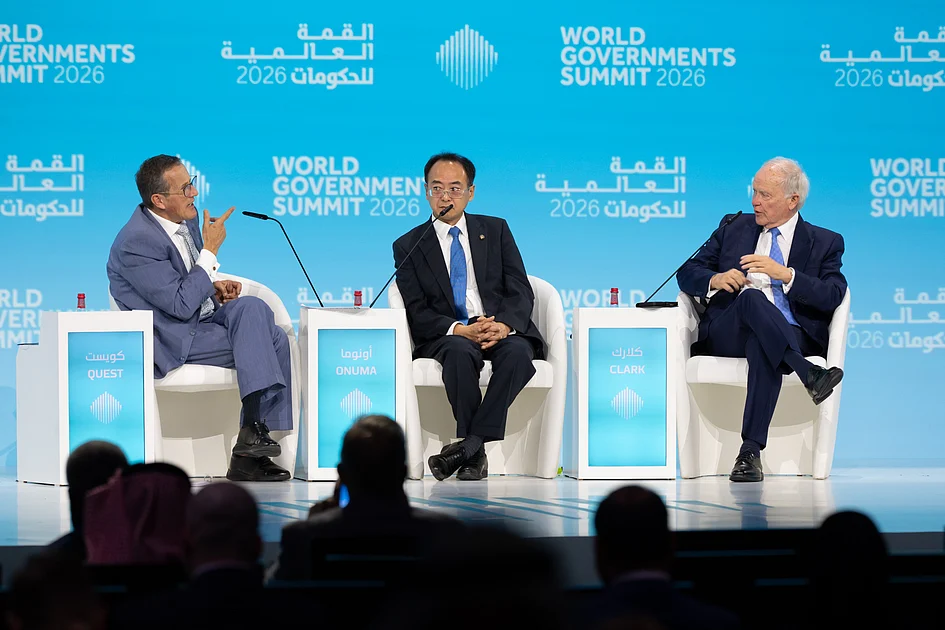
Dubai’s aviation sector has established unprecedented global standards in biometric systems and seamless travel technology, positioning the emirate as the world’s foremost innovator in passenger experience. Emirates Airline President Sir Tim Clark revealed this technological leadership during the World Government Summit, contrasting Dubai’s advanced implementation with the European Union’s delayed adoption of similar digital systems.
Speaking alongside International Civil Aviation Organisation President Toshiyuki Onuma at a session titled “What is the next destination for Aviation,” Clark detailed Dubai’s successful deployment of frictionless airport technology that eliminates physical interventions. “We’ve been advancing the pace so we can process passengers through Dubai without any kind of physical interdiction at all,” Clark stated, emphasizing that the technology has been operational for years while the EU’s recent digitization efforts remain overdue.
The aviation leaders identified commercial space launches as a critical challenge facing the industry. Clark highlighted how private space companies, particularly SpaceX, have disrupted civil aviation when launches encounter problems. “Every time one of these things goes wrong, it can completely screw up civil aviation hundreds of thousands of miles,” he noted, despite fortunately avoiding catastrophic losses.
Onuma acknowledged the need for careful evaluation of emerging technologies, stating that stakeholders often present biased views requiring objective analysis. Both leaders agreed that while commercial space ventures should not be impeded, enhanced coordination is essential as companies like Blue Origin expand low Earth orbit operations.
Regarding airspace management, Clark praised the Middle East’s “Herculean” progress in modernizing systems compared to other regions. He specifically commended the rapid advancements in Qatar and the United Arab Emirates, while criticizing Europe’s need for fundamental airspace management restructuring to address congestion and efficiency challenges.
The discussion concluded that the primary obstacles to global aviation modernization are not technological capabilities but rather harmonized ground systems and coordinated international approaches among stakeholders with divergent national agendas.