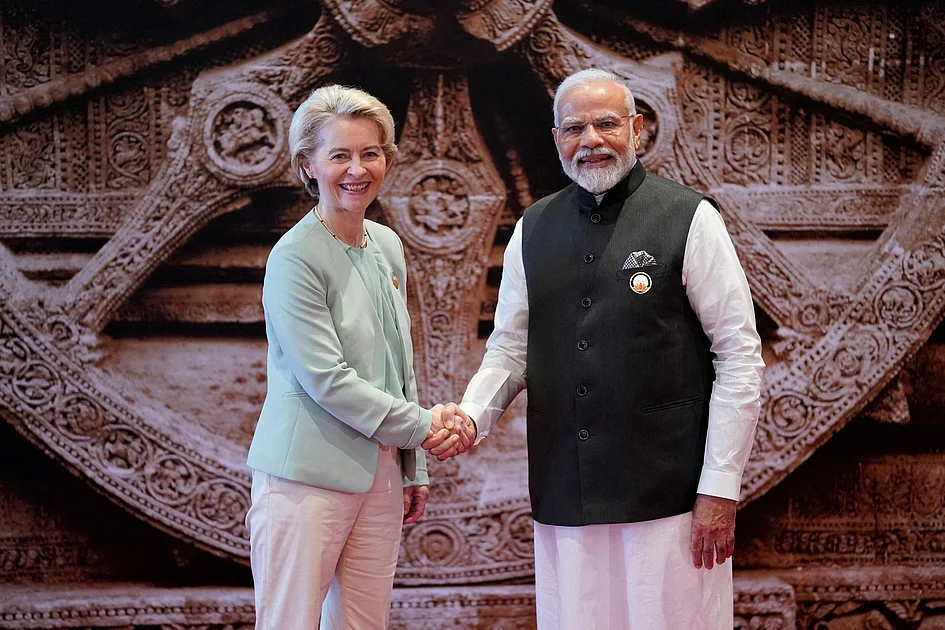
In a significant geopolitical shift, India and the European Union are finalizing a comprehensive free trade agreement, strategically timed to counter growing global trade volatility. The pact, dubbed the ‘mother of all deals,’ represents a decisive move to establish stable trade corridors amid increasing unpredictability in US trade relations under the Trump administration.
European Commission President Ursula von der Leyen and European Council President António Costa have arrived in New Delhi for the 16th EU-India Summit on January 27, where officials anticipate announcing the conclusion of negotiations that have spanned nearly two decades. While formal signatures may follow later, the political commitment marks a watershed moment in EU-India relations.
The agreement emerges against a backdrop of escalating US tariff pressures, with some Indian exports facing duties as high as 50%. This environment has transformed the EU-India negotiation from a conventional economic initiative into a strategic safeguard mechanism. The partnership aims to secure predictable trade rules, diversify market access, and reduce vulnerability to abrupt policy changes from traditional partners.
The scale of existing trade underscores the agreement’s potential impact. Two-way goods trade between India and the EU reached approximately $136 billion in FY2024/25, making the bloc India’s largest goods trading partner. The proposed FTA would expand this economic corridor across multiple sectors—from industrial goods to services—while addressing persistent non-tariff barriers and regulatory friction.
This development reflects India’s broader ‘portfolio approach’ to trade diplomacy, systematically building bilateral agreements to broaden market access and attract foreign investment. A recent example includes the ambitious agreement with the UAE, targeting a doubling of bilateral trade to $200 billion within six years after surpassing $100 billion under the CEPA framework.
Despite the breakthrough, sensitive issues remain unresolved. Agriculture remains politically contentious, with the most sensitive agricultural matters temporarily excluded from negotiations. Additionally, Europe’s Carbon Border Adjustment Mechanism (CBAM) presents concerns for Indian industries fearing new carbon-based charges on exports.
The EU has simultaneously pushed for stronger intellectual property protections and data governance assurances. Beyond commercial elements, the summit is expected to yield a comprehensive strategic package including defense cooperation, information security agreements, and mobility frameworks covering skilled workers, students, and researchers.
Trade analysts characterize the impending agreement as India’s clearest signal yet of its strategy to build overlapping trade alliances as economic shock absorbers. In an era of tariff threats and shifting trade blocs, both New Delhi and Brussels appear determined to establish a historic economic corridor before the next wave of global trade turbulence emerges.