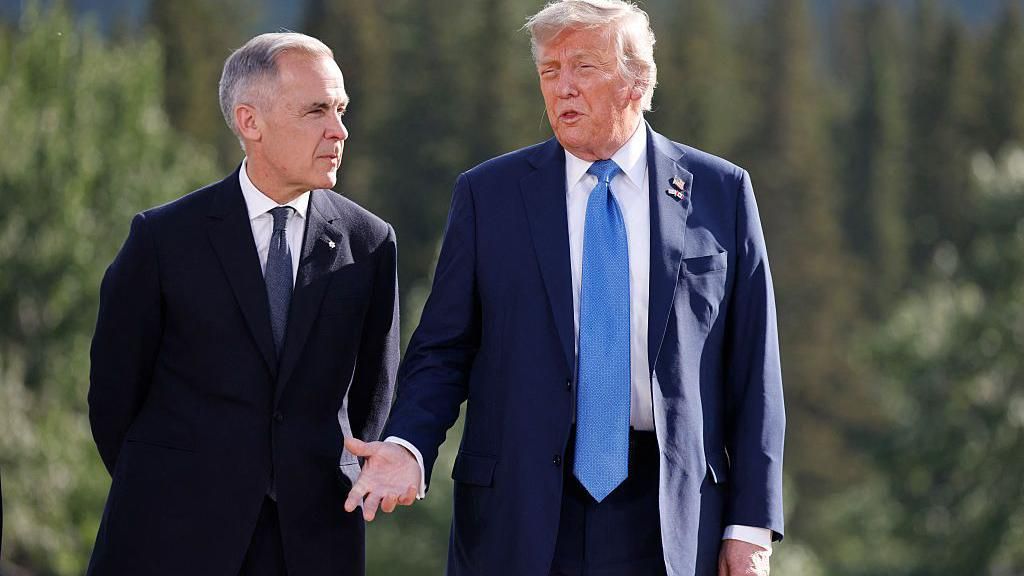
In a significant escalation of diplomatic tensions, former U.S. President Donald Trump has threatened to impose 100% tariffs on all Canadian goods should Prime Minister Mark Carney finalize a trade agreement with China. The warning was issued via Trump’s Truth Social platform on Saturday, where he specifically targeted Canada’s potential role as a transit point for Chinese products entering the United States.
The confrontation follows Carney’s recent address at the World Economic Forum in Davos, Switzerland, where he criticized great power politics without directly naming Trump. The Canadian leader’s subsequent meeting with Chinese President Xi Jinping resulted in announcements of a bilateral trade agreement covering electric vehicles and agricultural products—a development Trump initially praised but now vehemently opposes.
Trump’s rhetoric has intensified considerably, referring to Carney as ‘Governor Carney’ and reviving previous characterizations of Canada as America’s ’51st state.’ This linguistic framing accompanies substantive policy threats, including the withdrawal of Canada’s invitation to join the newly formed ‘Board of Peace,’ an international conflict resolution body proposed by the Trump administration.
The underlying tensions reflect broader strategic disagreements, including Canada’s opposition to Trump’s proposed missile defense system in Greenland (dubbed ‘The Golden Dome’) and fundamental differences regarding NATO and international governance structures. Carney’s assertion that Canada’s relationship with China has become ‘more predictable’ than its relationship with Trump’s America highlights the profound shift in North American dynamics.
Trade experts observe that Canada’s diplomatic recalibration toward China stems from persistent uncertainty in U.S.-Canada relations, particularly since Trump’s return to office last year brought new tariffs on Canadian goods. The ongoing review of the countries’ free trade agreement adds another layer of complexity to these developments.
Both the White House and Carney’s office have declined to comment on whether the referenced China-Canada trade agreement has been formally implemented, leaving the precise catalyst for Trump’s latest threat unclear.