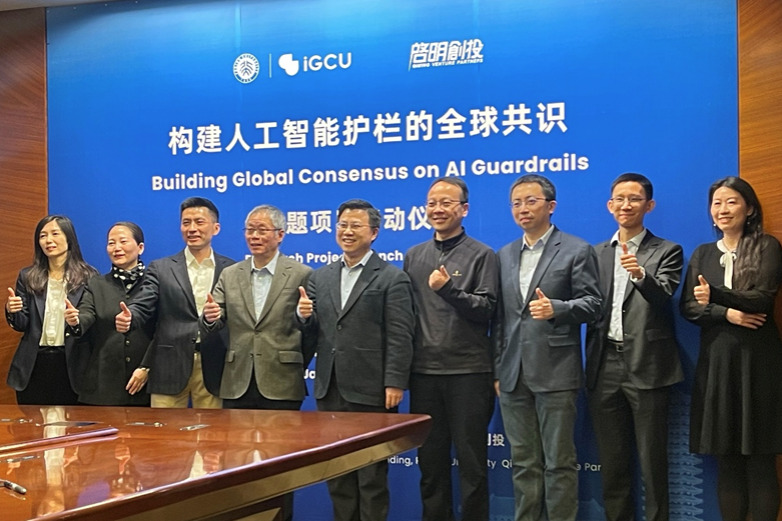
A landmark international research initiative titled “Building Global Consensus on AI Guardrails” was formally inaugurated in Beijing on Friday, bringing together prominent scholars from China, the United States, and other nations. The project addresses the urgent need for coordinated global action to establish safeguards for responsible artificial intelligence development and deployment.
Professor Jia Qingguo, Director of the Institute for Global Cooperation and Understanding at Peking University, emphasized the critical nature of this endeavor in a video address. “Given our existing understanding of AI risks, the stakes are very high,” he stated. “We must address the challenges and risks AI poses to avoid ending up in a disaster unparalleled in history. Since AI is a global phenomenon, effective risk management presents significant challenges that demand international cooperation.”
The ambitious project will develop a comprehensive policy and implementation blueprint that maps existing AI governance frameworks worldwide. Its primary objectives include identifying areas of convergence and divergence across different regulatory approaches and proposing concrete mechanisms to build global consensus on implementing responsible AI safeguards.
Professor Wang Dong, Executive Director of the same institute, highlighted the current fragmentation in global AI governance. He noted persistent divisions among nations regarding risk assessment methodologies, technological boundaries, and governance implementation pathways. This research initiative aims to bridge these gaps through scholarly collaboration and evidence-based policy recommendations, creating a foundation for more harmonized international AI governance standards that balance innovation with ethical considerations and risk mitigation.