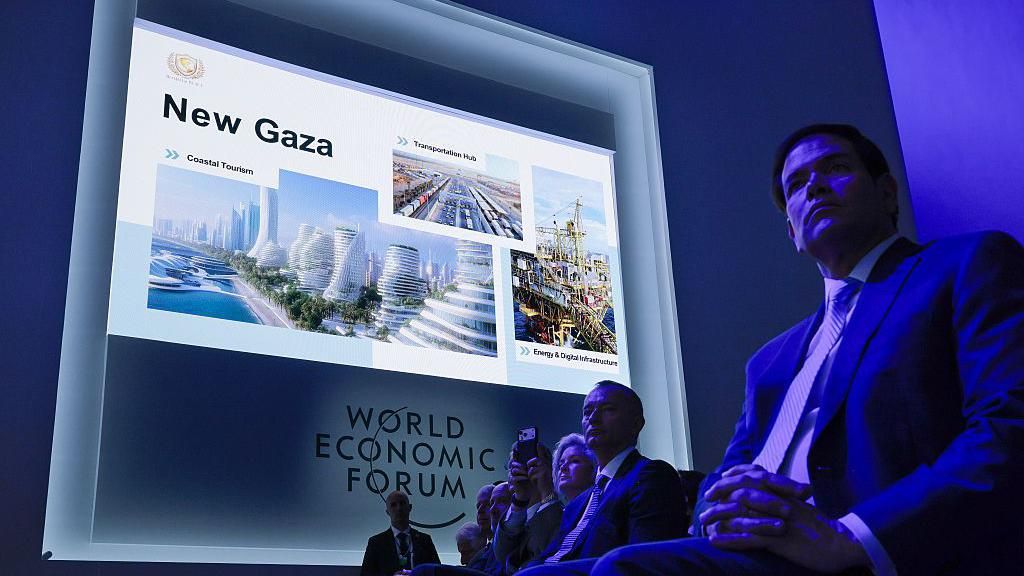
DAVOS, SWITZERLAND – The Trump administration has presented a comprehensive vision for the complete reconstruction of the Gaza Strip, dubbed the “New Gaza” plan, during a signing ceremony at the World Economic Forum. The ambitious proposal outlines a total transformation of the war-ravaged Palestinian territory into a modern urban and economic hub.
The detailed master plan, presented by former President Donald Trump and senior advisor Jared Kushner, features extensive coastal skyscrapers, residential estates in Rafah, and designated zones for agriculture, industry, and technology. The blueprint includes 180 tower blocks for coastal tourism, over 100,000 permanent housing units, 200 educational centers, and 75 medical facilities. A new seaport and airport near the Egyptian border are planned, along with a “trilateral crossing” where Egyptian and Israeli borders converge.
President Trump emphasized the strategic value of Gaza’s Mediterranean location, stating, “I’m a real estate person at heart and it’s all about location. Look at this beautiful piece of property. What it could be for so many people.” He expressed confidence that the project would achieve “great success.”
The reconstruction would proceed in four phases, beginning in Rafah and expanding north toward Gaza City. A notable feature includes an empty security perimeter along the Egyptian and Israeli borders where Israeli forces will remain until “Gaza is properly secure.”
Kushner revealed the staggering scale of destruction facing the project: 90,000 tonnes of munitions dropped on Gaza and 60 million tonnes of rubble requiring clearance. He announced that demolition and rubble removal operations have already commenced, with the “New Rafah” phase projected for completion within two to three years.
The plan is intrinsically linked to the demilitarization of Hamas, with Trump warning, “They have to give up their weapons and if they don’t do that, it’s going to be the end of them.” Kushner added that the administration is pursuing “catastrophic success” without a “plan B,” noting that Hamas has signed an agreement to demilitarize.
A Washington conference is scheduled in the coming weeks to announce international contributions and outline investment opportunities for the private sector. The newly established National Committee for the Administration of Gaza (NCAG) will work with Hamas on demilitarization efforts.
Despite the ceasefire that took effect in October, tensions remain. Five Palestinians were reportedly killed by Israeli fire on Thursday, highlighting the fragile nature of the current peace. Humanitarian conditions remain dire, with nearly 1 million people lacking adequate shelter and 1.6 million facing acute food insecurity according to UN estimates.
International responses varied, with Israeli President Isaac Herzog praising Trump’s leadership while emphasizing that “the real test has to be Hamas leaving Gaza.” Palestinian Authority President Mahmoud Abbas called for full implementation of the peace plan, including Israeli withdrawal, and a central role for the PA in administering Gaza.
The Rafah border crossing with Egypt is scheduled to open next week in both directions, signaling what NCAG head Ali Shaath described as Gaza being “no longer closed to the future and to the war.”