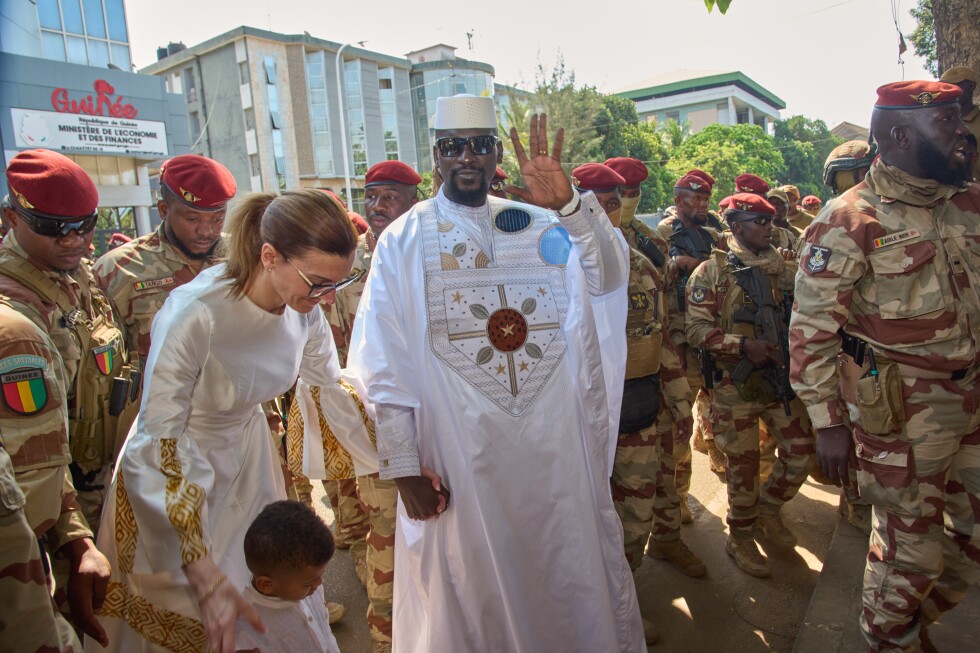
CONAKRY, Guinea — Guinea’s Supreme Court has officially validated the presidential election victory of General Mamadi Doumbouya, formally transitioning the military junta leader into a democratically elected head of state. The court’s Sunday ruling confirmed Doumbouya’s overwhelming mandate, with official results showing he secured 86.7% of votes cast in the December 28 election—the nation’s first presidential contest since the 2021 coup.
The judicial endorsement comes despite earlier challenges from opposition candidate Yero Baldé, who had alleged electoral manipulation before unexpectedly withdrawing his petition just prior to the court’s decision. Baldé finished as runner-up with 6.59% of the vote.
In a nationally televised address following the verdict, President Doumbouya struck a conciliatory tone, declaring: “Today, there are neither winners nor losers. There is only one Guinea, united and indivisible.” He called upon citizens to collaborate in building “a new Guinea, a Guinea of peace, justice, shared prosperity, and fully assumed political and economic sovereignty.”
The electoral process occurred under a newly implemented constitution that notably eliminated previous restrictions prohibiting military leaders from seeking presidential office while simultaneously extending the presidential term from five to seven years.
Political analysts note that Doumbouya faced minimal opposition during the campaign, with critics alleging his administration has systematically suppressed political dissent since seizing power in 2021. N’Faly Guilavogui, a Guinean political analyst, observed that the weakened opposition landscape focused attention exclusively on Doumbouya as “the only key figure capable of ensuring the continuity of the state.”
The newly confirmed president inherits significant economic challenges despite Guinea’s substantial mineral wealth. As the world’s largest exporter of bauxite—a crucial component in aluminum production—the nation paradoxically struggles with pervasive poverty. World Food Program data indicates over half of Guinea’s 15 million citizens experience record levels of food insecurity and economic hardship.
Among the junta’s most significant economic initiatives is the Simandou iron ore project, representing the world’s largest untapped deposit of its kind. The mining venture, 75% Chinese-owned, commenced operations in December following decades of developmental delays, potentially offering future economic revitalization.