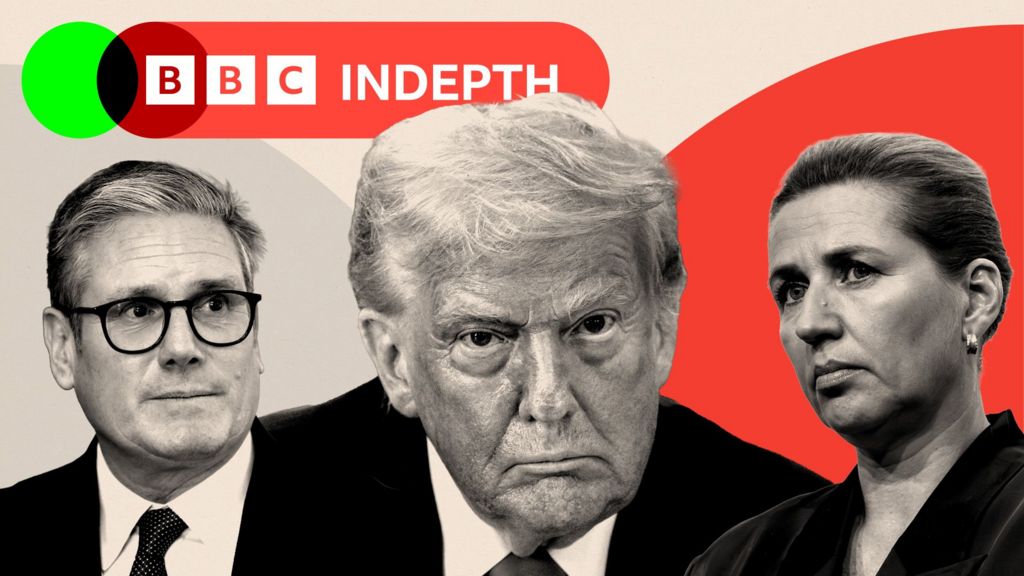
A profound rupture in transatlantic relations has emerged as former President Donald Trump’s renewed campaign to acquire Greenland has triggered an unprecedented diplomatic confrontation with European allies. During his Monday address, Trump reiterated his position that the United States “has to have” the semi-autonomous Danish territory for national security purposes, while confidently predicting limited European resistance.
The situation escalated dramatically when Trump began pressuring Denmark’s NATO and EU allies to abandon Copenhagen or face punitive tariffs on all exports to the United States. This ultimatum represents a fundamental shift in how Washington leverages economic power for geopolitical objectives, effectively weaponizing trade against military allies.
European leaders responded with remarkable unity and defiance. German Finance Minister declared, “we will not allow ourselves to be blackmailed,” following emergency consultations with French counterparts ahead of the World Economic Forum. French Finance Minister Roland Lescure characterized the moment as “uncharted territories,” noting that “an ally, a friend of 250 years, is considering using tariffs… as a geopolitical weapon.”
The EU has prepared a formidable countermeasure: €93 billion in retaliatory tariffs targeting American goods, with potential restrictions on US financial and technology firms’ access to the European single market. This economic leverage is substantial—EU investors employ 3.4 million Americans across all 50 states, and the bloc accounts for nearly 16% of global trade.
Beyond economic ramifications, the crisis threatens to undermine European security architecture. While UK Prime Minister Keir Starmer emphasized the continuing importance of US-UK defense cooperation, particularly regarding nuclear deterrence, European officials expressed deep concerns about the reliability of American security guarantees under the current administration.
The confrontation has global implications, with Russia and China closely observing the Western alliance’s fragmentation. Beijing particularly views Trump’s perceived unreliability as an opportunity to position China as a more stable international partner, evidenced by Canada’s recent limited trade agreement with China to reduce Washington exposure.
Complicating matters further is Trump’s parallel establishment of a “Board of Peace,” which France has already rejected due to concerns about its challenge to United Nations primacy. The invitation extended to Russian President Vladimir Putin despite ongoing hostilities in Ukraine has raised additional questions about the initiative’s credibility.
As leaders converge in Davos, European diplomats are adopting a revised strategy combining firm resistance with continued engagement. EU Commission officials emphasize that “our priority is to engage, not escalate,” while simultaneously preparing robust countermeasures should Trump proceed with his Greenland tariffs.
The crisis represents a pivotal moment for transatlantic relations, testing whether decades of alliance can withstand the pressure of economic coercion over territorial acquisition. With 55% of Americans opposing Greenland’s purchase and 86% rejecting military action, the domestic political calculus remains uncertain as this geopolitical standoff continues to unfold.