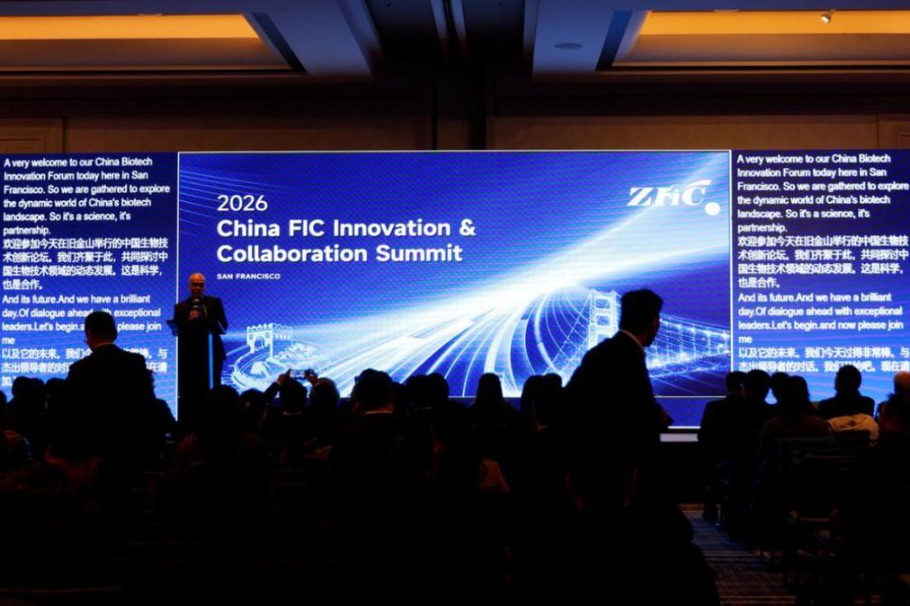
SAN FRANCISCO – Top pharmaceutical executives and global investors convened at the 2026 China FIC Innovation and Collaboration Summit on Sunday, signaling a new era of cross-border biotechnology cooperation as China’s drug licensing deals surpassed $130 billion in value last year.
The summit, organized by the Zhongguancun First-in-Class Innovative Drug Strategic Development Alliance, functioned as both a global showcase and launch platform for China’s most promising pharmaceutical innovations. The event specifically aimed to bridge Chinese biotech firms with international industry leaders while stimulating increased multinational investment in China’s rapidly expanding healthcare sector.
A representative from the Beijing Investment Promotion Service Center described China’s evolution from producing derivative ‘Me-Too’ medications to pioneering transformative ‘First-in-Class’ therapies as evidence of an entirely new innovation ecosystem. She characterized the summit as a ‘vital two-way bridge’ connecting global expertise with Chinese technological advancement.
China’s pharmaceutical ascendancy rests on several foundational strengths: a unified market of 1.4 billion people with healthcare coverage extending to 1.33 billion citizens provides unprecedented scale for clinical development and commercialization. The country’s regulatory framework now operates in full compliance with International Council for Harmonisation guidelines while balancing innovation incentives with accessibility through volume-based procurement systems.
Regulatory approvals have accelerated dramatically, with Chinese authorities greenlighting a record 76 innovative drugs in 2025 alone. These streamlined review processes have created clearer pathways for synchronized global drug development and simultaneous international market launches.
Despite global geopolitical tensions, Chinese Consul General in San Francisco Zhang Jianmin emphasized that economic interdependence remains an undeniable reality. ‘The biopharmaceutical sector depends fundamentally on global supply chains, cross-border clinical research, and international data sharing,’ Zhang noted. ‘Many challenges exceed any single nation’s capabilities – US-China collaboration immeasurably increases our chances of solving humanity’s most pressing health challenges.’
California State Treasurer Fiona Ma reinforced this collaborative vision, highlighting the state’s substantial healthcare investments through voter-approved bonds for stem cell research, children’s hospitals, and behavioral health services. ‘With AI capabilities and digital connectivity, we must abandon research silos,’ Ma stated. ‘Shared research accelerates discoveries and enhances global health outcomes.’
Industry veteran Joseph Scheeren of the French National Academy of Pharmacy offered an optimistic assessment: ‘Chinese companies are moving aggressively toward global expansion through partnership deals that position them as worldwide development partners. With sufficient resources and continued commitment, China possesses extraordinary potential in pharmaceutical innovation.’
The summit revealed significant untapped potential – while China now contributes approximately 30% of the global innovative drug pipeline, only a fraction of these developments have involved international transactions. Nine cutting-edge projects were selected from nearly 30 applications for detailed pitching sessions, spanning multiple therapeutic areas and technological frontiers.