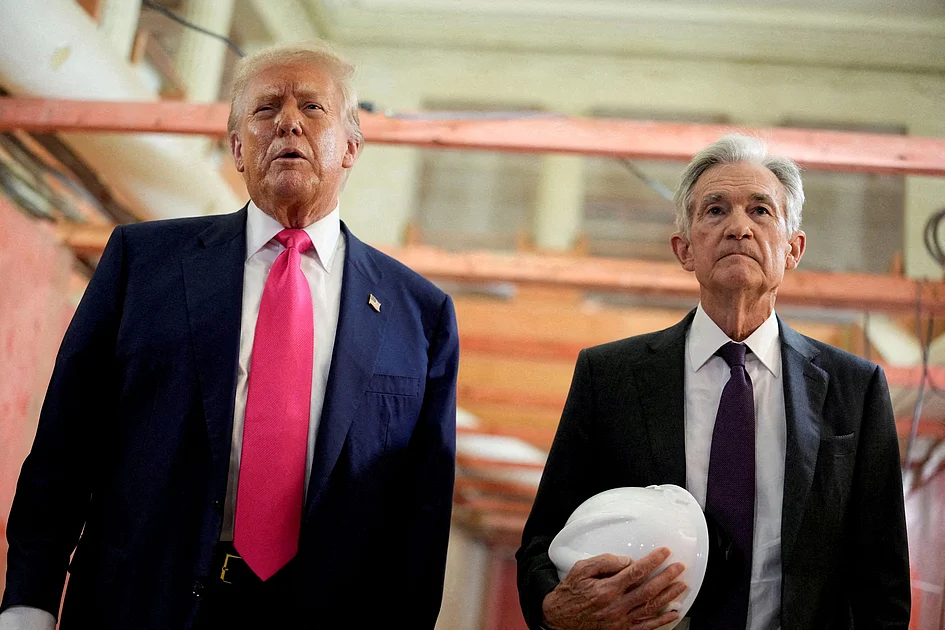
A deepening institutional crisis at the US Federal Reserve is sending shockwaves through global financial markets, with Gulf Cooperation Council (GCC) economies positioned for direct impact due to their dollar-pegged currencies. The unprecedented criminal investigation launched against Fed Chair Jerome Powell by the District of Columbia US attorney’s office—reportedly over central bank headquarters renovations—has escalated tensions between the White House and monetary authorities to dangerous levels.
Market indicators immediately reflected investor anxiety, with S&P 500 and Nasdaq futures dropping over 0.6% pre-market opening. The VIX volatility index, known as Wall Street’s ‘fear gauge,’ recorded its sharpest rise since November 2025, while gold prices surged to $4,600 per ounce as investors sought traditional safe-haven assets.
According to Edward Bell, Acting Chief Economist at Emirates NBD, ‘The Fed’s independence, once considered sacrosanct, now faces existential challenges. We anticipate effectively operating under two distinct Federal Reserve systems in 2026—the current Powell-led framework and a post-May structure under new leadership.’
Financial experts interpret the investigation as retaliatory action against Powell’s perceived reluctance to accelerate interest rate reductions. With Powell’s term concluding in May 2026 and President Trump expected to announce his successor imminently, concerns mount that political interference could permanently damage the Fed’s credibility and operational autonomy.
Vijay Valecha, Chief Investment Officer at Century Financial, warned: ‘Prolonged uncertainty may trigger heightened market volatility, increased equity risk premiums, and further depreciation of the US dollar. We anticipate accelerated capital flows into protective instruments including precious metals and Treasury securities.’
For GCC nations maintaining dollar pegs, monetary policy remains inextricably linked to Federal Reserve decisions. Regional central banks historically mirror US rate adjustments, with another 75 basis points in cuts anticipated for 2026. While lower borrowing costs could stimulate GCC real estate development and dividend-yield investments, banking sector net interest margins may face compression.
Bell noted that regional economies demonstrate resilience: ‘UAE and Saudi economic indicators performed strongly throughout 2025 despite elevated rates. Further reductions will provide welcome stimulus but unlikely to dramatically accelerate growth trajectories.’
The dollar peg creates complex dynamics for Gulf states. Weaker regional currencies increase import costs but enhance competitiveness for non-oil exports, particularly service sectors. Notably, substantial import volumes from markets like India and Turkey—whose currencies depreciated against the dollar in 2025—have partially offset broader inflationary pressures.
Investment strategists recommend GCC investors implement robust risk management protocols, including portfolio diversification and maintaining liquidity buffers. While short-term market corrections may occur, the region’s strong fundamentals, political stability, and business-friendly environments provide substantial long-term support for capital markets.