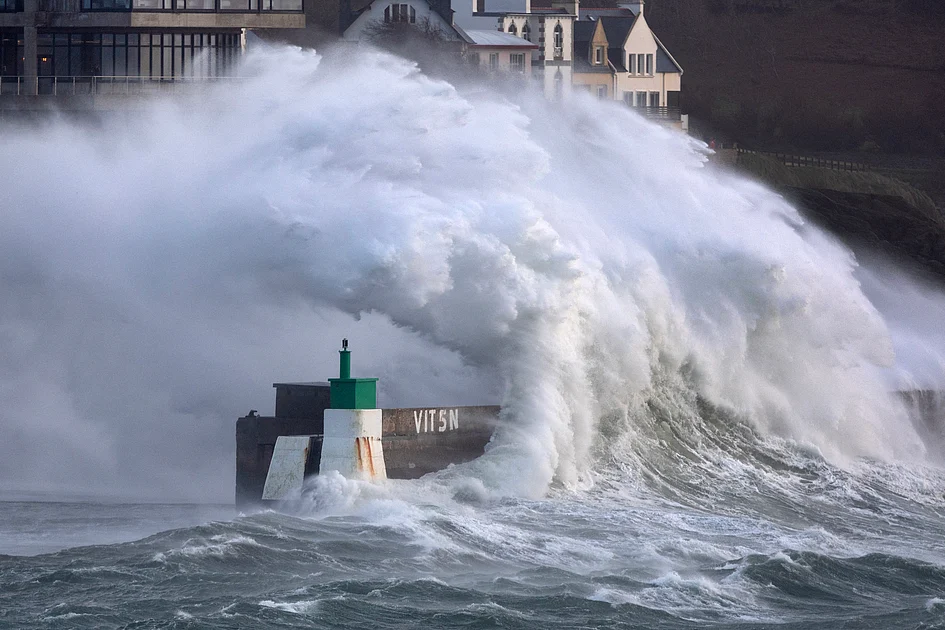
A powerful weather system named Storm Goretti descended upon Europe on Thursday, bringing a dangerous combination of extreme winds, heavy snowfall, and freezing temperatures. Meteorological agencies across the continent issued severe warnings, predicting significant disruptions to daily life and infrastructure from Britain to Germany.
In the United Kingdom, the Met Office took the rare step of issuing its highest-level red wind alert for southwestern England, including the Isles of Scilly and Cornwall. Forecasters warned of potentially catastrophic wind gusts reaching 160 kilometers per hour (100 mph), accompanied by dangerously large coastal waves. Simultaneously, an amber snow warning covered Wales, the Midlands, and northern England, with predictions of up to 30 centimeters (11 inches) of accumulation. The severe conditions prompted National Rail to advise against all non-essential travel for the next 48 hours as train services faced inevitable disruptions.
Across the Channel, northern France prepared for similar onslaught, particularly in the Manche department where schools were ordered closed for Friday. Authorities issued urgent safety directives across 30 northwestern regions, advising residents to seek shelter and avoid vehicle use while ensuring emergency supplies of lighting and drinking water.
Germany’s meteorological service (DWD) reported approaching heavy snow and powerful winds expected to cripple transportation networks and public services. Northern regions braced for up to 15 centimeters (6 inches) of snow, while southern areas faced hazardous icy conditions. The cities of Hamburg and Bremen preemptively canceled school for Friday as public transport networks already experienced significant delays on Thursday. Deutsche Bahn mobilized over 14,000 employees to combat the expected infrastructure challenges.
Meteorologist Andreas Walter of the DWD noted the exceptional nature of this storm compared to recent milder winters, directly linking the pattern shift to climate change. While cold snaps with substantial snowfall remain possible despite rising global temperatures, Walter emphasized such events would become increasingly rare in the future.
Adding to the extraordinary weather patterns, Norway’s Meteorological Institute reported that only one region in the entire country recorded temperatures above freezing on Thursday: the Arctic archipelago of Svalbard.