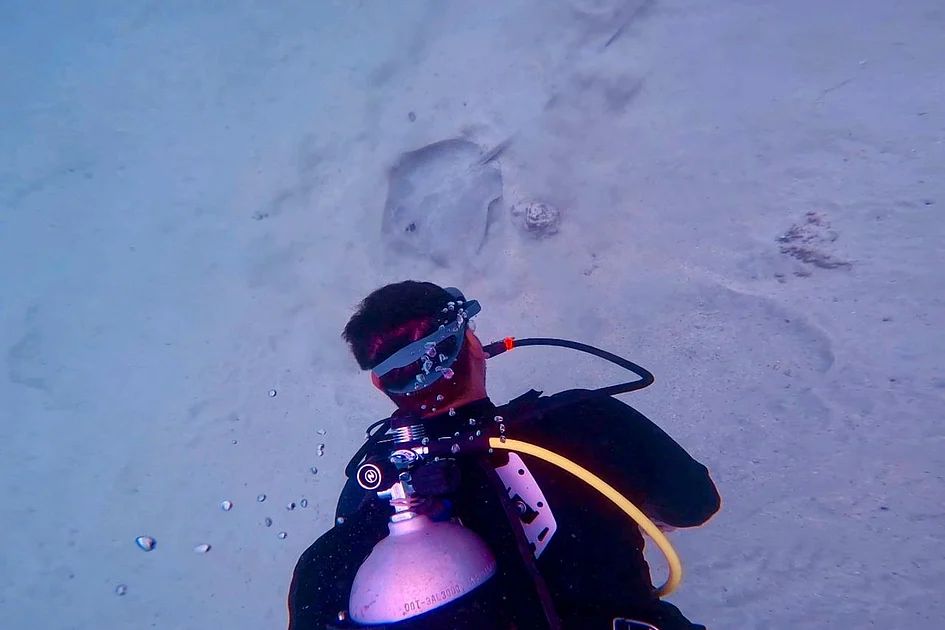
A routine dive off Fujairah’s coast has evolved into an internationally recognized marine conservation program, demonstrating how individual action in UAE waters can catalyze global environmental change. The initiative began when diving professional Mudasir Wajid encountered a critically entangled stingray pinned to the seabed by over 100 meters of abandoned fishing line at Martini Rock, a popular dive site.
Wajid recalls the critical moment: ‘When I observed the ray’s spiracles slowing, it became evident the animal was suffocating. Intervention transformed from optional to urgent.’ This single rescue operation ultimately led to the development of the Ocean Guardian Rescue Diver Specialty, now formally accredited by PADI, the world’s leading diving organization.
The program addresses dangerous misconceptions about marine rescue. ‘Well-intentioned but untrained interventions often exacerbate situations for animals, reefs, and divers alike,’ explains Wajid, a PADI Course Director with over 15 years and 3,500 dives of global experience. The curriculum emphasizes that intervention is only justified when threats are clearly human-generated, such as ghost nets, fishing hooks, or plastic pollution.
Central to the training is risk management. ‘Task loading constitutes the silent killer,’ Wajid warns. ‘Rescuers become so focused on entanglement that they neglect air supply, buoyancy, and decompression limits.’ The course instills a ‘Stop, Breathe, Think’ methodology, requiring thorough assessment of equipment, team readiness, and gas reserves before any action.
The training also addresses practical challenges. Standard dive knives often prove ineffective against heavy monofilament lines, necessitating specialized serrated tools. Untrained rescuers frequently rush to cut lines without considering tension dynamics, potentially causing whiplash recoils that endanger both animals and humans.
Environmental protection remains paramount. ‘One misplaced fin kick can devastate coral growth decades in the making,’ Wajid notes. Rough handling can compromise fish slime coats—their primary immune defense—leading to post-rescue fatalities from infection.
The program emphasizes that responsible conservation sometimes requires restraint. When conditions prove too hazardous or animals too large/reactive, documentation and reporting through official channels become the most professional response. This philosophy shifts focus from ‘cowboy heroics’ to systematic protocols that prioritize safety and ecological integrity.
This Fujairah-born initiative now supports the UAE’s broader sustainability objectives while providing divers worldwide with standardized techniques for addressing marine entanglement—proving that trained witnesses and informed responders ultimately serve the ocean better than unchecked heroism.