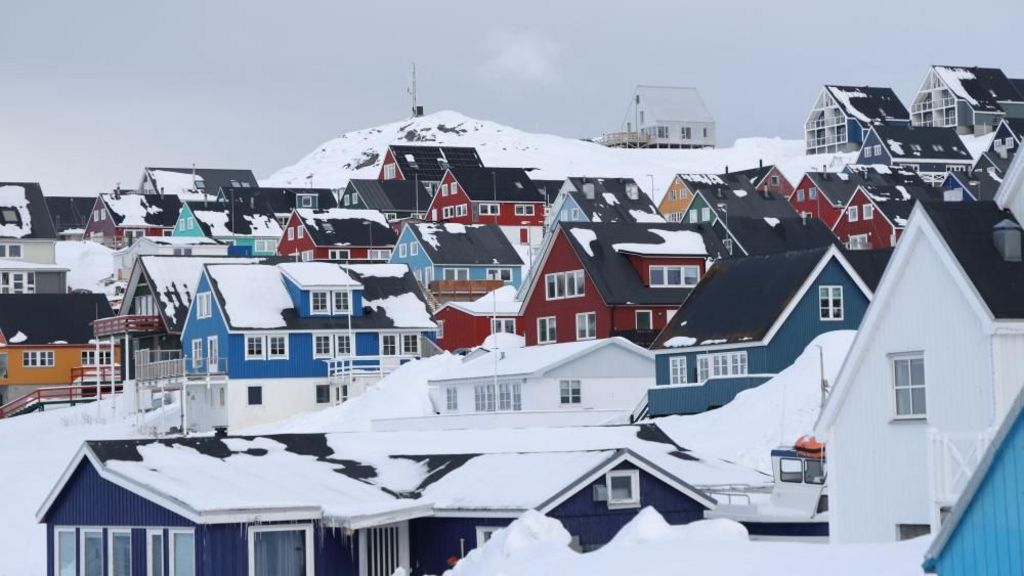
In a dramatic escalation of geopolitical tensions, former and current U.S. President Donald Trump has renewed his campaign to acquire Greenland, citing urgent national security concerns. The controversial proposition has been met with firm resistance from both Greenland’s autonomous government and Denmark, creating an unprecedented rift between the NATO allies.
Following a military operation in Venezuela that resulted in the capture of President Nicolás Maduro, Trump intensified his calls for American control over the strategic Arctic territory. ‘We require Greenland from the standpoint of national security,’ Trump asserted to journalists. ‘The region is overwhelmingly strategic. Presently, Russian and Chinese vessels dominate the surrounding waters.’
Greenlandic Prime Minister Jens Frederik Nielsen delivered a sharp rebuke, characterizing Trump’s annexation ambitions as pure ‘fantasy’ and demanding an end to the pressure campaign. Danish Prime Minister Mette Frederiksen reinforced this position, declaring that the United States possesses no legitimate claim to any territory within the Danish realm.
This territorial dispute represents a reactivation of Trump’s 2019 offer to purchase the island, which Denmark previously dismissed as nonsensical. Since returning to the White House in January 2025, Trump has not excluded military options, alarming European partners. The administration has further provoked Copenhagen through high-level diplomatic maneuvers, including Vice-President JD Vance’s visit to Greenland in March 2025, where he accused Denmark of inadequate investment in territorial defense.
The appointment of special envoy Jeff Landry in late 2025, who openly advocates for Greenland’s incorporation into the United States, ignited fresh diplomatic hostilities. The world’s largest non-continental island possesses growing geopolitical significance due to its position in the rapidly changing Arctic region, where melting ice caps are unlocking access to substantial deposits of rare earth minerals, uranium, and iron ore.
While Trump maintains that his interest is purely security-driven, historical context reveals deeper motivations. The U.S. military has maintained a continuous presence in Greenland since World War II, when American forces preemptively invaded following Nazi Germany’s occupation of Denmark. The Pituffik Space Base (formerly Thule Air Base) remains a critical component of America’s missile defense system, with experts noting its vital role in intercepting potential Russian nuclear strikes via the polar route.
Historical archives reveal that American attempts to acquire Greenland date back to 1867, when Secretary of State William H. Seward pursued acquisition shortly after securing Alaska from Russia. Another substantial offer of $100 million was presented in 1946, equivalent to approximately $1.2 billion today, but rejected by Danish authorities.
Despite Greenland’s colonial history and current status as a semi-autonomous Danish territory, polling indicates strong local support for eventual independence—though overwhelmingly opposed to American annexation. As one resident emphatically told BBC correspondent Fergal Keane: ‘Greenland belongs to Greenlanders. Trump can visit but that’s it.’
The escalating confrontation represents one of the most significant diplomatic challenges to transatlantic relations in modern history, testing the resilience of NATO alliances and international norms regarding territorial sovereignty.