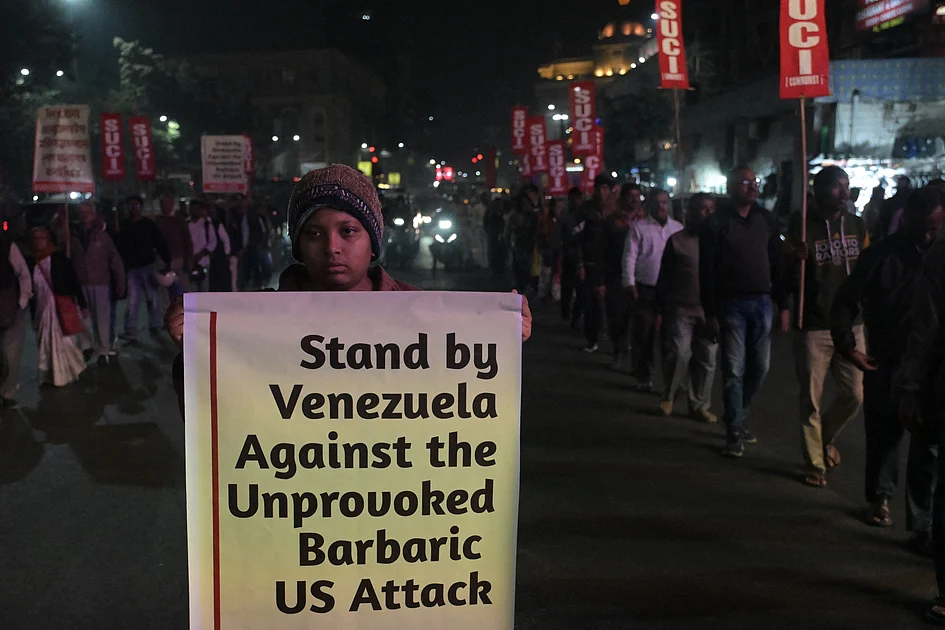
Political analysts from the United Arab Emirates have characterized the United States’ military operation resulting in the capture of Venezuelan President Nicolás Maduro as establishing a profoundly ‘troubling precedent’ that degrades the established framework of international law. The action, confirmed by US President Donald Trump via a post on Truth Social, involved large-scale strikes on Venezuelan territory and culminated in the detention of Maduro and his wife, who were subsequently transported to a New York detention facility to face drug and weapons charges.
This dramatic escalation follows months of heightened tensions between the two nations, during which President Trump repeatedly advocated for regime change in Venezuela and issued an ultimatum in November for Maduro to relinquish power. Experts assert that while the US has a history of unilateral military interventions, directly targeting and extracting a sitting head of state from a sovereign nation marks an unprecedented evolution in foreign policy.
Jesse Marks, CEO of Rihla Research & Advisory LLC, condemned the maneuver as a descent into ‘mafia-style politics,’ ushering in a ‘new era of Godfather-style foreign policy.’ He emphasized that the operation was conducted without congressional approval, a UN Security Council mandate, or any recognized legal framework, thereby constituting a ‘persistent degradation of international law.’
Emirati columnist Eisa Eisa Abdalla AlZarooni noted the strategic use of language by the Trump administration, which framed the operation not as a conventional intervention but as a ‘national security’ and judicial action by linking the Venezuelan leadership to organized crime. This narrative, AlZarooni argues, is a tactical tool to justify the use of military force outside a UN mandate, effectively redefining sovereignty not as a guaranteed right but as a state’s ability to protect itself—a shift he labeled ‘dangerous’ for the global order.
The aftermath presents significant challenges. Dr. Paulo Botta of TRENDS Research & Advisory drew parallels to the 1990 capture of Panamanian leader Manuel Noriega, suggesting the impact will resonate most profoundly on the rules of the international system itself, where ‘pure realism reigns supreme.’ Internally, Venezuela faces a critical power vacuum concerning control over its armed forces, intelligence services, and financial flows. Kristian Alexander of Rabdan Academy warned that ensuing chaos could empower drug traffickers and criminal elements to expand their influence, exploiting a lack of governance. Alexander concluded that regardless of its branding as law enforcement, the forceful capture of a sitting leader to oversee governance constitutes de facto regime change.