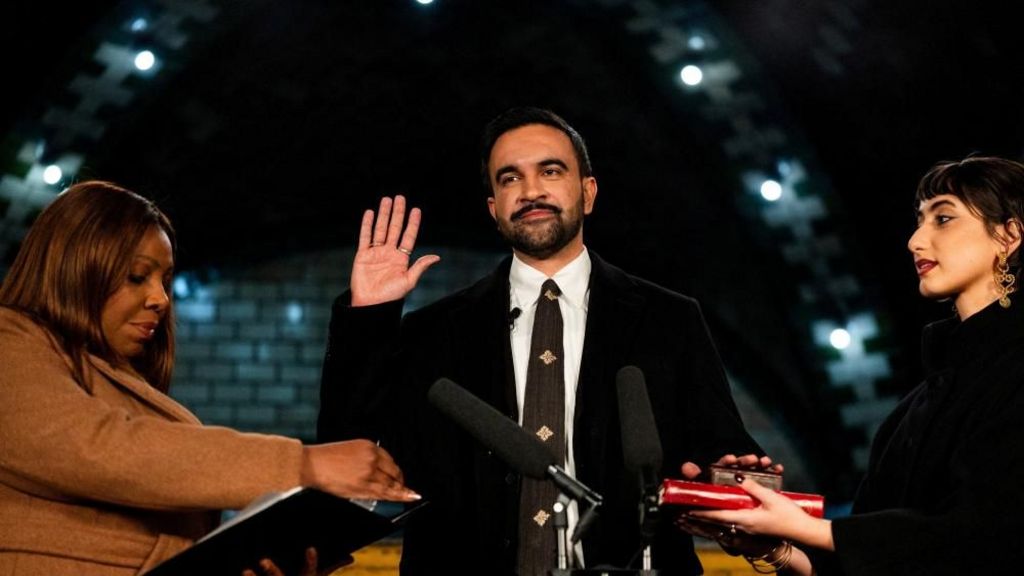
Zohran Mamdani has officially been inaugurated as New York City’s 110th mayor, marking a historic moment as the first Muslim to hold the office. The 34-year-old democratic socialist achieved an unexpected electoral victory through an unconventional social media strategy that resonated powerfully with younger demographics.
His campaign captivated voters through viral content demonstrating unorthodox engagement tactics—from plunging into Coney Island’s winter waters to illustrate his “rent freezing” policies to examining food truck permitting processes causing “Halalflation.” These carefully crafted moments presented Mamdani as an accessible, authentic figure contrasting with traditional political candidates.
According to Associated Press data, approximately 75% of voters under age 30 supported Mamdani. American University communications professor Jane Hall noted this success stemmed from presenting “an image of a political candidate that young people—frustrated with older, more established candidates—craved.” Rutgers University’s Professor Jack Bratich observed Mamdani’s unique ability to “combine lightheartedness with serious conversations.”
The new mayor faces immediate challenges in transitioning from viral campaigning to effective governance. Columbia University’s Ioana Literat warned that without honestly addressing governmental constraints, “the same young people who made him go viral can just as quickly turn that energy into disillusionment.”
Mamdani’s relationship with the Trump administration remains particularly consequential. Despite an unexpectedly cordial November meeting where they discussed shared concerns about New York’s affordability crisis, President Trump had previously labeled Mamdani an extremist “lunatic” and threatened to withhold federal funding. Their dynamic will significantly impact Mamdani’s ability to implement his progressive agenda.
NYU’s Jonathan Nagler noted the difficulty in maintaining engagement: “It’s easy to mobilize people to oppose Trump. What’s much harder is to go on social media and say: ‘Hey, the New York City Council is in my way.’”
The incoming administration seeks to sustain momentum through Our Time for an Affordable NYC, an independent advocacy group founded by former volunteers that aims to advance Mamdani’s affordability agenda through grassroots organizing. This structure hopes to transform his 100,000+ volunteer network into enduring political capital.
Mamdani took his oath of office in the abandoned City Hall subway station—a symbolic location connecting New York’s historical infrastructure with his forward-looking vision. “This is truly the honor and the privilege of a lifetime,” he declared, ready to confront the complexities of governing America’s largest city.